Why a Facebook page isn't enough for your business
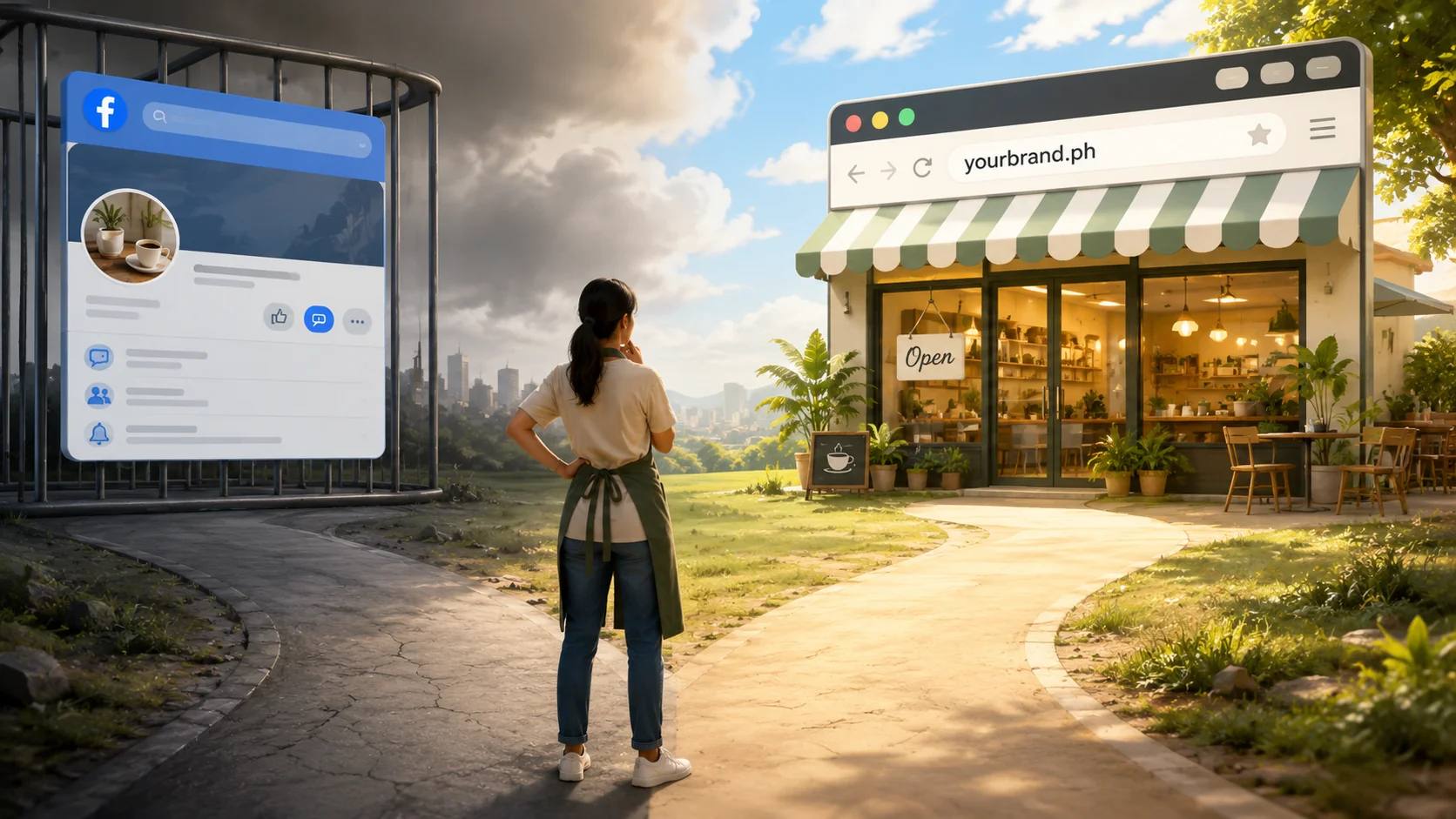
Filipinos are among the world's heaviest social media users. There are roughly 95.8 million social media identities in the country — about 81.9% of the population [1] — and Facebook still reaches close to 95% of Filipino internet users [2]. With numbers like that, a Facebook page can feel like a complete online presence, and as a starting point it genuinely is one. The problem starts when the page is the only place customers can find you: you're building your business on ground you rent, not ground you own. Here's the straight version of what that costs a Philippine business, and what a real website does that a page can't.
Isn't a Facebook page enough if that's where all my customers already are?
It's a fair question, because the attention really is there. Filipinos spend close to nine hours a day online — among the highest anywhere [3] — and much of that time sits inside Facebook and Messenger. But "where attention starts" and "where business gets done" aren't the same place. A page is excellent for getting noticed; it's a weak place to close a sale, hold your customer records, or show up when someone is ready to buy. Treating the page as your whole shop means leaning on a channel built to keep people scrolling, not to send them to your checkout.
What do I actually own when my business lives on a Facebook page?
Less than it feels like. You don't own the audience, the reach, or the rules — the platform does. Follower counts keep climbing nationally, with social media identities rising by around nine million in a single year to hit 95.8 million [4], but those followers are borrowed. If your account is restricted, your reach is cut, or the algorithm changes overnight, there's no appeal and no backup. A website is an asset you control: your domain, your content, your customer list. Nobody can suspend it or bury it under a competitor's ads.
Why do so few of my followers actually see my posts?
Because organic reach on Facebook has been shrinking for years. Industry tracking now puts the average reach of a business page's post in the low single digits — often cited around 6.5% of followers, and frequently lower [5]. The mechanism is universal: the feed is pay-to-play, and the platform favours content that keeps people on the platform, then sells you ads to reach the audience you already built. So even a page with thousands of followers may be talking to only a small fraction of them each time it posts.
Will Filipino customers take my business seriously without a website?
Often, no. When Filipinos are about to spend real money, they research first — checking whether a business looks credible before they trust it with their payment and personal details [6]. A business with only a thin Facebook page quietly reads as "small" or "risky," while a clean, fast site with clear information does the opposite. Local research on online buyers keeps landing on the same trust signals: a professional presence, secure checkout, and visible proof the business is real [7]. That credibility is the entire point of professional website development.
Can people even find my business on Google if I only have a page?
Rarely in the way you'd want. When someone searches "[your service] near me" or "[your product] Philippines," a Facebook page seldom ranks well, and it gives you almost no control over how you appear. Worse, cautious buyers are told to verify sellers through official channels — DTI or SEC registration and a proper website — before paying [8]. If a search for your name turns up nothing but a page, you fail that check. A website with proper SEO can rank for the exact terms buyers type, putting you in front of people actively looking to buy — every day, without paying per click.
How much buying actually happens outside Facebook anyway?
A lot, and it's growing fast. Philippine e-commerce is on track to rise from about US$17.65 billion in 2025 toward roughly US$20 billion in 2026 [9], and a large share of Filipino internet users now shop online every single week [10]. That demand doesn't live on your page — it lives in search results, marketplaces, and branded stores where people are in buying mode. A page can spark interest, but you need somewhere to send that interest that's actually built to take the order.
Can I really sell and get paid properly straight from a Facebook page?
Not at any real volume. "Comment mine" and "PM sent for the total" works for a handful of orders, but it doesn't scale — it's manual, error-prone, and it leaves you chasing screenshots of payments. A website lets customers browse, choose, and pay on their own schedule, and it records what sells so you can actually see what's working. If selling is the point, that structured checkout is what our e-commerce development is built to give you.
Does a website let me accept GCash and Maya like the big shops do?
Yes — and this is where a lot of owners assume a page is easier than it is. GCash alone reports more than 94 million registered users in the Philippines [11], so buyers expect to pay with an e-wallet at checkout. A local gateway like PayMongo wires GCash, Maya, cards, and bank transfers into your own website at published per-transaction rates, with no setup or monthly fee [12]. We cover the full setup in our guide to adding GCash and Maya. Your own site can feel exactly as trusted at payment as any marketplace stall.
What can my own site do that a Facebook page simply can't?
Own the relationship, mainly. On your site you capture the customer's contact details, so you can bring them back instead of paying to reach them again. You control the whole experience — layout, story, bundles, loyalty, security badges that reassure cautious buyers [13]. You get real analytics, you rank on Google, and you keep every peso of margin instead of renting attention. A page borrows an audience; a website compounds one you actually own.
Isn't a website expensive and slow to build compared to a free page?
It costs more up front than a free page, but far less than the sales you quietly lose to looking unprofessional or being invisible on Google. Scope drives the price — pages, products, integrations — which we break down in our guide to website costs in the Philippines. A lean, well-built site usually pays for itself once it starts converting the search traffic and repeat buyers a page never could, and it keeps working for you around the clock.
So should I quit Facebook and just build a website?
No — it's both, playing different roles. Social media is genuinely excellent for attention, community, and discovery, and with nearly 96 million social identities in the country you'd be foolish to abandon it [1]. But a page is the top of the funnel, not the whole thing. Use Facebook to get noticed and spark interest; use your own site to convert that interest into trusted, trackable, fully owned sales. One brings people in, the other turns them into business.
What's the first step to move beyond a Facebook page?
Start with a simple, credible home you own: a fast website with your services, proof you're legitimate, clear contact details, and a real checkout that takes GCash and Maya. Point your social bio and posts at it, and let it do the closing while Facebook does the noticing. When you're ready to stop renting your entire presence, that's exactly what our website development is built for.
Sources & references
- Social Media Statistics in the Philippines (2026) — Meltwater (95.8 million social media identities; 81.9% of the population).
- Filipinos spend nearly equal time on TikTok, Facebook (Digital 2026 report) — GMA News (Facebook used by 94.9% of internet users).
- Internet economy in the Philippines — statistics & facts — Statista (daily time online, highest in Asia-Pacific).
- PH social media identities up 9M, hit 95.8M — GMA News.
- For brands, Facebook is now a content publisher, not a community — Content Marketing Institute (average organic reach around 6.5% of followers).
- Brand trust & data privacy in the Philippines — Think with Google (consumers research extensively before buying).
- How website design impacts buyer trust and your ability to sell — Maya Business.
- How to check if a website is legitimate in the Philippines (DTI, SEC, red flags) — Respicio & Co..
- Philippines E-commerce Market size and growth — Mordor Intelligence (US$17.65B in 2025 toward US$20.05B in 2026).
- Philippines: weekly e-commerce activities of internet users — Statista.
- GCash: the rise of a financial super app — FinTech Magazine (more than 94 million registered users).
- Pricing — PayMongo (per-transaction rates; no setup or monthly fees).
- 9 important website credibility signals that influence online shopping behaviour — Maya Business.
Social media, e-wallet, and e-commerce figures were current as of publication and change frequently — confirm the latest DataReportal/Meltwater, GCash, and PayMongo numbers before deciding. Facebook organic-reach figures [5] are a global benchmark used here because the algorithm behaves the same way in the Philippines; no PH-specific equivalent is published. Market-size and reach figures are third-party estimates and vary by methodology.
Ready to own your presence? Let's build you a home online.
Start a project arrow_right_alt