Adding GCash and Maya payments to your business website
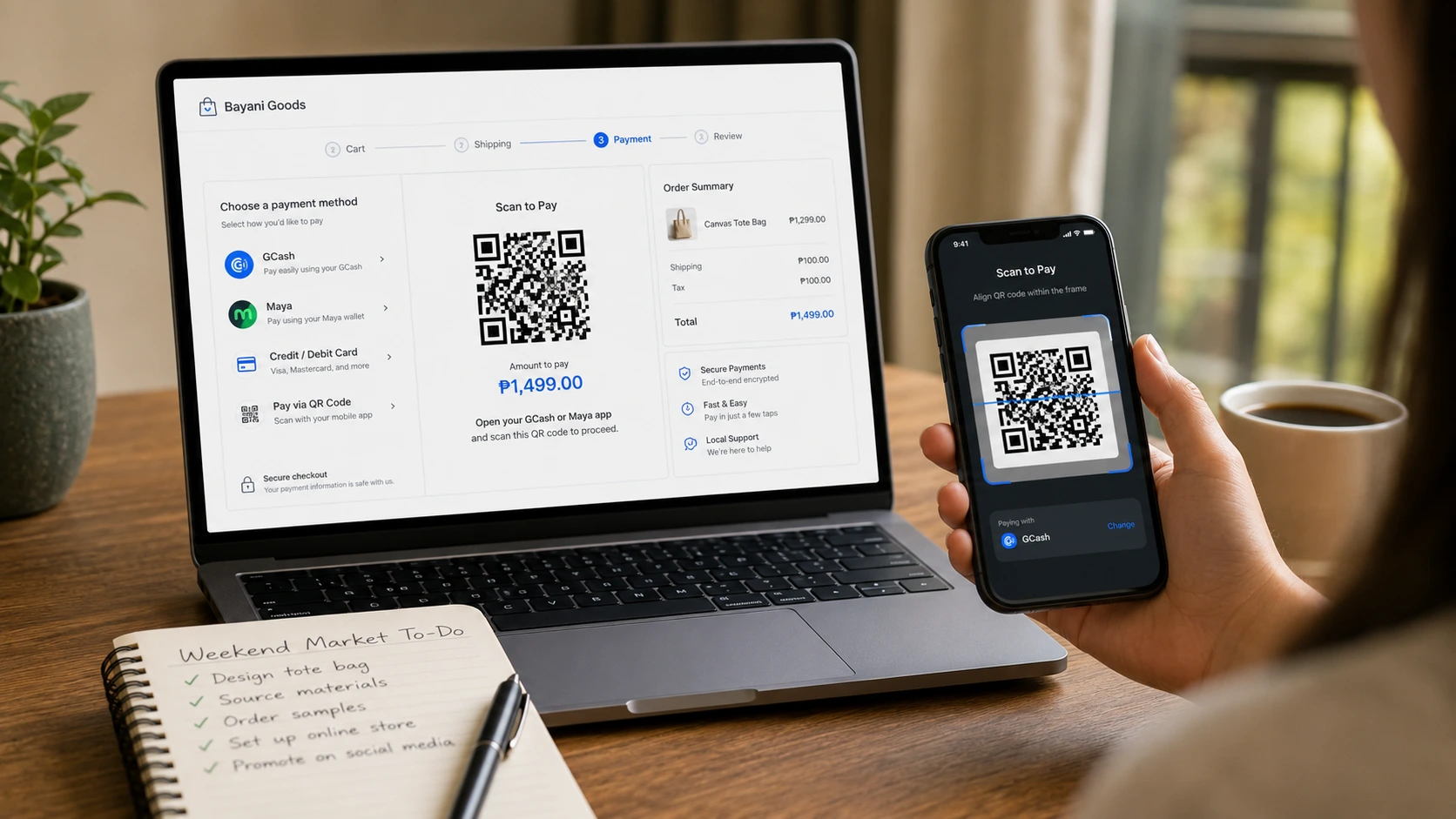
If you sell anything in the Philippines, letting people pay with GCash or Maya on your own website is no longer optional — it is what customers expect before they tap order. GCash has grown past 94 million registered accounts [1], and its parent reported roughly 39 million monthly active users moving around ₱17 trillion in a single year [2]. Both e-wallets now share the checkout spotlight with cards and cash on delivery as the default way Filipinos pay online. This guide answers the questions Philippine business owners actually ask when they want to wire GCash and Maya into their site properly — the integration paths, the real fees, settlement, refunds, QR Ph, and the trust details that move conversion.
Why do GCash and Maya matter so much for a Philippine business website?
Because this is now a cashless-first market, not a cash-first one experimenting with apps. Central bank figures show digital methods have overtaken cash — close to 60% of monthly retail payment volume and value ran through digital channels in 2024, up sharply from a few years earlier [3]. There are about 97.5 million Filipinos online, with internet reach near 84% of the population [4], and across Southeast Asia mobile wallets have become the everyday way people move money rather than a niche add-on [5]. For a local business, that means a checkout without GCash and Maya quietly turns away buyers who have the app open and no card on hand.
How do GCash and Maya actually get onto your website?
Through a payment gateway, in almost every case. Rather than integrating each wallet separately, you connect one Philippine gateway that already speaks to GCash, Maya, cards, and bank transfer, then drop its checkout into your site. PayMongo, for example, exposes GCash, Maya, ShopeePay, cards, and bank options through a single account with one integration [6]. Xendit works the same way — a BSP-regulated gateway that bundles the major local methods behind one connection [7]. On a hosted platform like Shopify the gateway plugs into the existing checkout; on a custom storefront we call the gateway's API directly. Either way, your customer stays on your site and the wallet redirect is handled for you.
Should you use a payment gateway or apply to GCash and Maya directly?
For most small and mid-sized businesses, start with a gateway. Applying directly to GCash for Business or Maya Business can win you a lower headline rate — Maya publishes merchant discount rates that begin below 2% for some methods [8], and GCash lists its own tiered rates on QR Ph and card sales [9] — but you sign a direct merchant agreement, handle onboarding and compliance for each wallet, and wait through a longer approval. A gateway gets you both wallets plus cards live in days with one contract. The usual path: launch on a gateway, then revisit direct merchant deals once your monthly volume is high enough that shaving half a percent actually matters.
What do GCash and Maya payments really cost in fees?
Less than most owners fear, and the wallets are usually cheaper than cards. Through PayMongo, e-wallet transactions like GCash sit in the low-2% range while cards run around 3.5% plus a small fixed peso fee, with no setup or monthly charge [10]. Xendit's published Philippine schedule is broadly similar — cards near 3.2% plus a fixed fee, e-wallets a little lower [7]. Going direct can trim those figures further: Maya's merchant discount rates start under 2% for some methods [8], and GCash applies tiered rates that can be very low on QR Ph once you pass a monthly threshold [9]. Budget a rough 2–3.5% of each order for the payment layer, then treat any direct-merchant discount as an optimisation for later.
What is QR Ph, and should your website use it?
QR Ph is the national interoperable QR standard from the Bangko Sentral ng Pilipinas: one merchant QR code that any participating bank or e-wallet app can scan, so you are not juggling a separate code per provider [11]. Gateways expose it as a checkout option too — PayMongo can generate a QR Ph code that pulls from GCash, Maya, and dozens of banks at once [6], and Maya Business supports the same standard [11]. Adoption has been steep: person-to-merchant QR Ph value jumped from a few billion pesos to roughly ₱55 billion in a single year after the standard rolled out [12]. For a website it is most useful at pickup counters or invoices; for online checkout, the direct GCash and Maya buttons are still the smoother flow.
How long before the money reaches your bank account?
Typically a day or two, not instantly. A wallet payment confirms to the buyer in seconds, but the gateway collects the funds and settles them to your linked bank on a schedule — commonly within one to two business days, with fees applied at the point of settlement rather than at checkout [13]. Some gateways offer faster or instant payouts for an extra fee [10]. The practical point for cash flow: the sale shows as paid immediately, but plan your restocking and payroll around the settlement window, not the confirmation screen.
How do refunds and disputes work with e-wallet payments?
Refunds run back through the same gateway, not out of your own GCash app. When a customer needs money back, you trigger the refund from the gateway dashboard and it returns to their wallet or card, which keeps your books clean and your records auditable [6]. Two habits save you grief: publish a plain-language refund and cancellation policy on the checkout page so expectations are set before payment, and keep the gateway's reference number attached to every order. That reference is what lets you and the customer trace a disputed or "paid but not received" transaction quickly instead of trading blurry screenshots.
Is it safe, and what trust signals actually convert at checkout?
The payment rails are safe — the gateways are BSP-regulated and the wallets carry their own security — so the risk that loses you sales is a checkout that merely looks untrustworthy. Filipino shoppers, most of them on mobile, bounce fast when a page feels off. A few details do the heavy lifting: serve the site over HTTPS with your real business name visible, show the official GCash and Maya wordmarks at the correct colour and size rather than a fuzzy copy, and display an on-screen reference number plus a confirmation email the moment payment succeeds. Offer both wallets rather than one — GCash skews broader and more nationwide while Maya has a strong, younger following — so you are never turning away someone because their preferred app is missing.
What does it cost to set up GCash and Maya on your site?
The gateway itself usually costs nothing to switch on — PayMongo and Xendit charge no setup or monthly fee and only take a cut of successful transactions [10][7]. The real cost is the build: wiring the checkout, testing it, and shaping the trust details around it. On a hosted platform that can be a small job; on a custom site it depends on how your cart or booking flow is structured. We break down the full picture in our guide to website costs in the Philippines, and you can scope your own project on our pricing page. Compared with the margin you keep by taking payment directly instead of through a marketplace, it pays back quickly.
Do you need an ecommerce checkout or a booking deposit flow?
It depends on what you sell, and the wallet integration follows the flow. For product businesses, GCash and Maya sit next to cards and cash on delivery on the cart page — the standard pattern we build through our ecommerce development service, often on Shopify via a Shopify payment integration so refunds and order tags live in one dashboard. For service businesses — studios, clinics, training centres — the wallet collects a fixed deposit (often 30–50%) that locks the slot, which is what our booking system development handles: pick a slot, get a reference number, pay the deposit, and only then is the booking confirmed. Our take on choosing a booking system goes deeper on that path.
What are the most common mistakes when adding e-wallets?
- Skipping the sandbox test. Gateways give you test keys for a reason. Run a low-value order end to end on a real phone before launch, not just on a desktop browser.
- Treating mobile as an afterthought. Most of your traffic is on a phone and the wallet redirect has to feel native. A desktop-style modal with a tiny close button will bleed sales.
- No fallback when the gateway hiccups. If a provider is momentarily down, don't leave a dead button — offer manual bank transfer with clear instructions so the sale survives.
- Hiding the reference number and receipt. Filipino buyers want a screenshot to send to their group chat. Show the reference and confirmation on screen and your support load drops.
How do you get started adding GCash and Maya to your website?
Decide which flow you need — full ecommerce checkout or a booking deposit — pick one Philippine gateway that covers both wallets, and get the trust details right before you chase a fractionally lower fee. If you are also weighing whether to lean on Shopee and Lazada versus your own store, our comparison of an own store versus a marketplace is a useful companion read. When you are ready to wire it up properly for your own store or booking page, that is exactly what we do — start with our pricing page or send us a message and we will map the right setup with you.
Sources & references
- GCash: The Rise of a Financial Super App (94M+ registered users) — FinTech Magazine.
- GCash parent Mynt bound for stock market (39.1M monthly active users, ₱17T GTV) — The Philippine Star.
- Digital payments post steady increase (~60% of retail volume and value, 2024 BSP data) — BusinessWorld.
- Digital 2025: The Philippines (97.5M internet users, 83.8% penetration) — DataReportal.
- Mobile wallets: Southeast Asia's new digital life hack — McKinsey.
- Online Payment Gateway — accept 14+ payment methods — PayMongo.
- Pricing — Xendit Philippines.
- Merchant discount rates — Maya Business.
- GCash Services Fees (merchant MDR schedule) — GCash.
- Pricing (no setup or monthly fees) — PayMongo.
- QR Ph — the national interoperable QR standard — Maya Business.
- QR Ph person-to-merchant transaction value, Philippines 2023 — Statista.
- Transaction fees and settlement timing — Xendit Docs.
Gateway rates, wallet user counts, and merchant terms change frequently and were current as of publication — reverify current PayMongo, Xendit, Maya Business, and GCash figures before you launch. The McKinsey reference covers Southeast Asia broadly rather than the Philippines specifically; all other figures are Philippine sources.
Want us to wire this into your site?
Talk to us arrow_right_alt