Own store vs Shopee/Lazada: which is right for you?
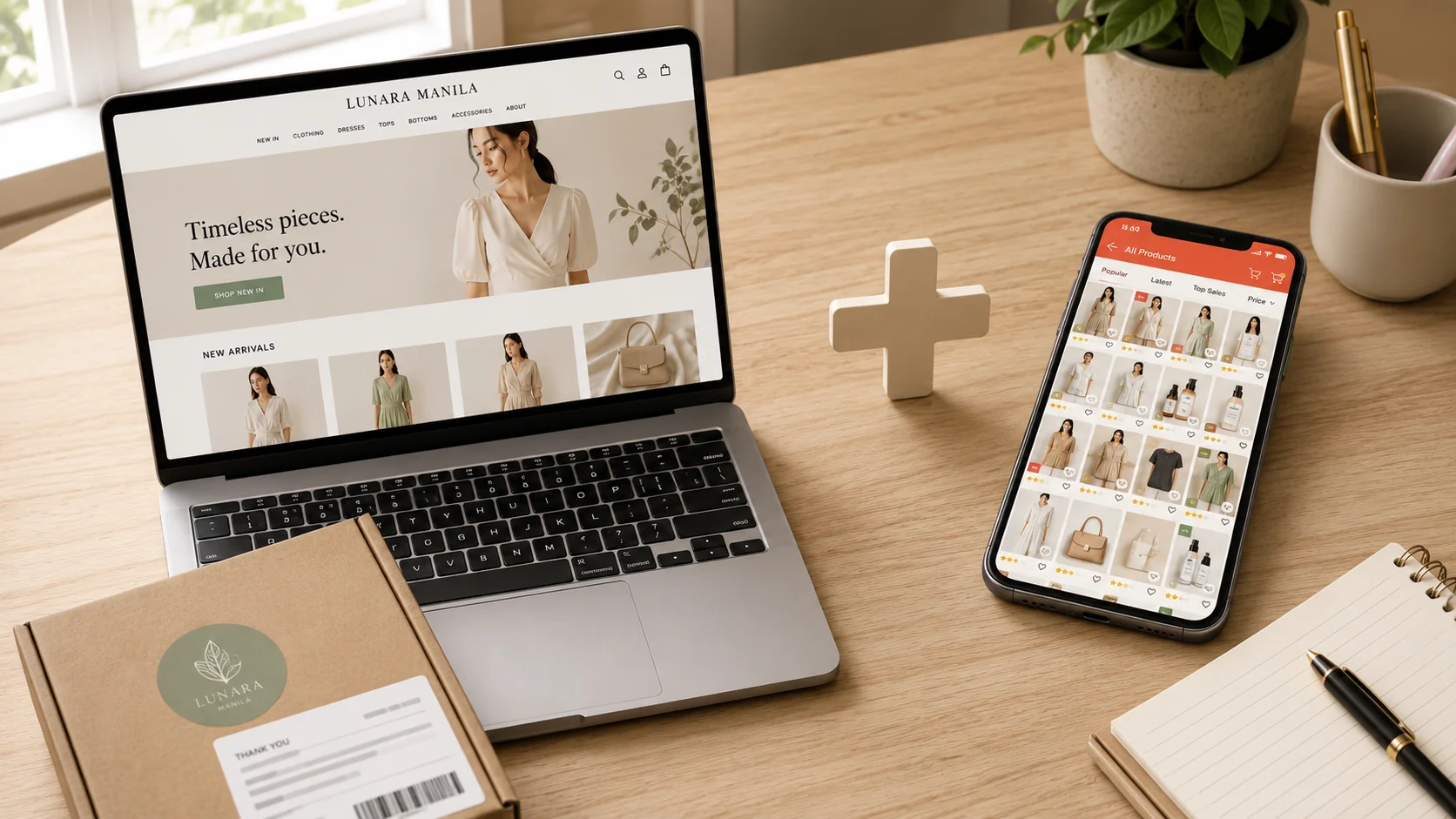
Every Philippine brand selling online eventually hits this fork: stay on Shopee and Lazada, or build your own store? They solve different problems, and picking the wrong one — or treating it as strictly either/or — quietly costs you margin and customers. Here's the straight version, with the local numbers that actually matter.
What do Shopee and Lazada actually do well for a Philippine seller?
Three things, and they're not small. First, built-in traffic — millions of Filipinos are already inside these apps searching to buy. Second, trust and logistics: payments, shipping, returns, and buyer protection are handled for you. Third, near-zero start-up effort, since you can be live in a day with no website at all. For a brand still testing whether a product sells, that's a genuinely sensible place to start.
How much do Shopee and Lazada really take in fees?
More than the "low commission" headline suggests, because the deductions stack. On Shopee Philippines a sale carries a category commission plus a transaction fee of around 2.24%, with optional programme fees (free shipping, cashback) layered on top — so a mid-range seller commonly loses somewhere in the region of 7–15% of each order once everything's counted [1]. Lazada applies a comparable transaction and processing fee on top of its commission and other order charges [2]. Local e-commerce enablers who reconcile these payouts every day make the same point: the real cost lives in the stacked deductions, not the advertised rate [3]. Add vouchers, free-shipping co-pays, and ads, and a meaningful slice of every peso leaves your pocket.
How big are Shopee, Lazada, and TikTok Shop in the Philippines?
Big enough that you can't ignore them, and highly concentrated. Philippine retail e-commerce is dominated by a few platforms, with the top two taking close to half of total market value and Shopee alone at roughly 31% [4]; Shopee leads on gross merchandise value while TikTok Shop has rapidly grabbed a large share of its own [5]. The overall market keeps expanding too, from about US$17.7 billion in 2025 toward US$20 billion in 2026 [6]. The takeaway: marketplaces own the discovery layer, which is exactly why they can charge for access to it.
What do you give up by selling only on a marketplace?
The customer. Their contact details, the relationship, and the next sale belong to the platform, not to you. Every store looks broadly the same, you mostly compete on price, and the algorithm decides who sees you. You're renting a spot on someone else's street — profitable while it lasts, but you never build an asset of your own.
What does your own online store do better?
It keeps your margin, since there's no per-sale commission to a marketplace. It lets you own the customer list, so you can remarket and bring people back. And it gives you a brand experience — bundles, loyalty, storytelling — that competitors can't copy. A real store can also rank on Google for your products, something a marketplace listing rarely does in your favour.
Doesn't a marketplace bring traffic your own store won't?
Yes — that's the honest trade-off, and a store with no marketing is a shop on an empty street. But the raw demand is there to capture directly: more than half of Filipinos now buy something online every week [7], and with roughly 96 million social media identities in the country [8], the cheapest traffic for most small brands is their own social following pointed at their own store — not paid marketplace placement.
Can your own store take GCash and Maya like the marketplaces do?
Yes, and this is the objection that's aged worst. GCash alone reaches more than 60 million users — over 80% of Filipino adults [9] — and a local gateway like PayMongo wires GCash, Maya, cards, and bank transfers into your own checkout at published per-transaction rates with no setup fee [10]. We walk through the full setup in our guide to adding GCash and Maya. Your store can feel exactly as trusted at checkout as a marketplace does.
Isn't building your own store expensive and slow?
It costs more up front than a free marketplace listing, but far less than the margin you hand over on every sale, forever. Scope drives the number — platform, product count, integrations — which we break down in our guide to website costs in the Philippines and the Shopify vs WooCommerce decision. For many brands a lean store pays for itself once repeat buyers stop routing through marketplace fees.
So should a Philippine brand choose a marketplace or its own store?
For most, it's not either/or — it's both, in sequence. Use marketplaces for discovery and first-time buyers who don't know you yet. Use your own store to convert loyal customers at full margin and build something you own. Marketplace-only makes sense while you're still validating a product; own-store-only makes sense once your brand already pulls its own demand.
How do you actually move repeat buyers to your own store?
Deliberately. Put a branded insert or discount code in every marketplace parcel, make your store the home for loyalty perks and new drops, and give people a concrete reason — better price, bundles, first access — to buy direct next time. The goal isn't to abandon Shopee and Lazada; it's to stop paying discovery fees on customers who already know your name. If you're ready to stop renting your sales channel, that's exactly what our e-commerce development is built for.
Sources & references
- Shopee PH Seller Education Hub — Seller Fees.
- Commission Fees for Selling on Lazada Philippines (2026 guide) — BigSeller.
- Shopee vs Lazada seller fees explained — Prosperna.
- Retail E-Commerce in the Philippines (market concentration and shares) — Euromonitor.
- GMV share of major e-commerce platforms, Philippines 2024 — Statista.
- Philippines E-commerce Market growth and size — Mordor Intelligence.
- Filipinos lead in online shopping (Digital 2026 Report, We Are Social & Meltwater) — GMA News.
- Social Media Statistics in the Philippines (2026) — Meltwater.
- The Philippines Growth Dialogues: GCash user base — McKinsey.
- Pricing — PayMongo.
Marketplace fees, platform market shares, and gateway rates change frequently and were current as of publication — confirm current Shopee, Lazada, and PayMongo rates before deciding. Market-share and GMV figures are third-party estimates and vary by methodology.
Thinking about your own store? Let's map the right setup for your brand.
Talk to us arrow_right_alt