How much does a website cost in the Philippines?
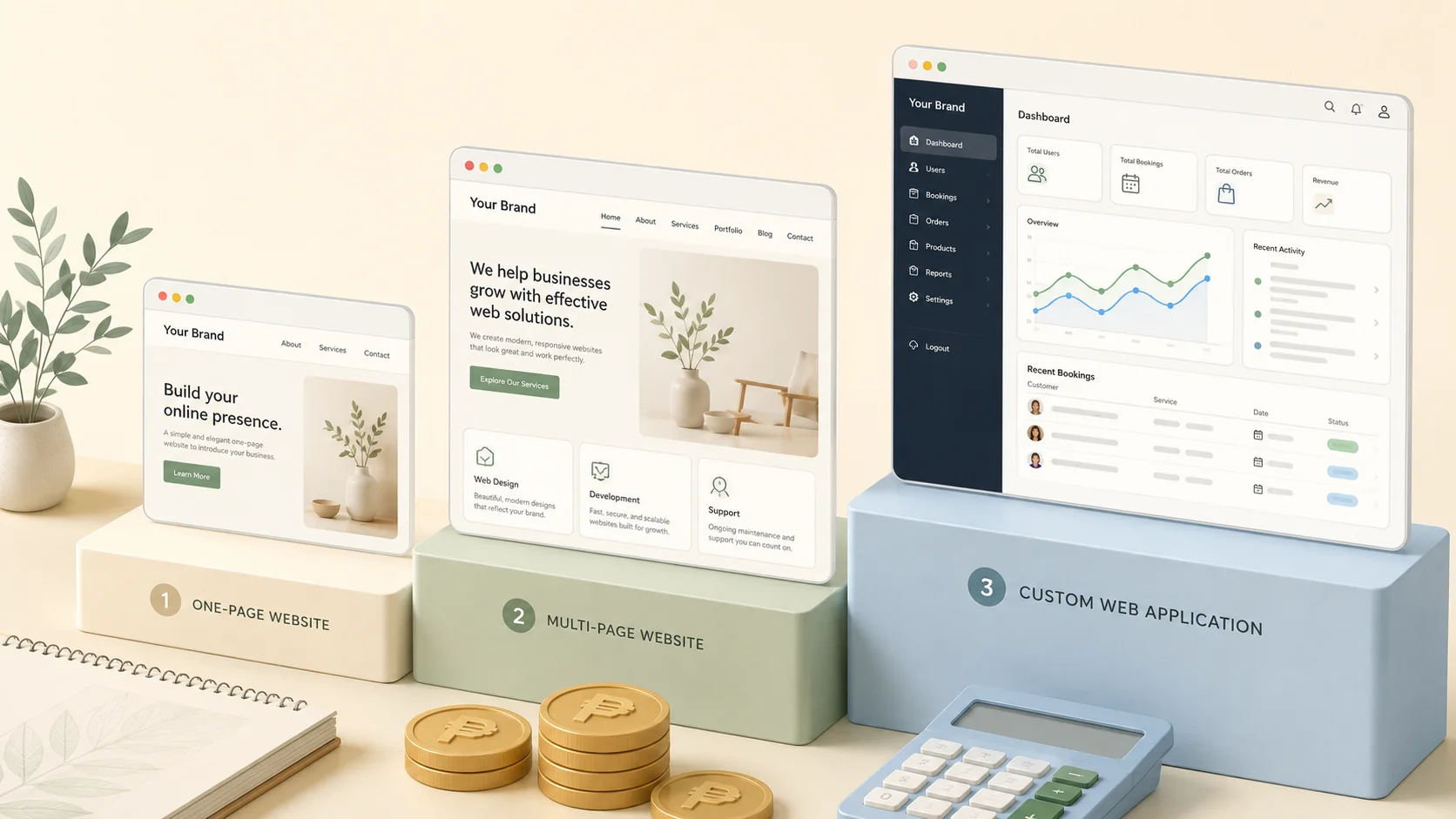
It's the first question almost every business owner asks, and the honest answer is: it depends on what you're actually buying. A "website" can mean a one-page brochure or a custom platform that runs your whole business. Here's a clear, Philippine-focused breakdown of what you'll pay in 2026 — and, just as importantly, what makes the number move.
How much does a website actually cost in the Philippines in 2026?
For a custom, professionally designed and built site, most Philippine projects land in a few clear bands. These reflect our own 2026 pricing and packages, and they're a realistic guide to what quality local studios charge:
- ₱35,000–₱60,000+ — Starter. A polished few-page marketing site: home, about, services, contact. Right for a new business establishing credibility.
- ₱60,000–₱120,000+ — Growth. More pages, a content system you can edit yourself, stronger SEO, and custom design. The sweet spot for established SMEs.
- ₱80,000–₱180,000+ — Commerce. A real online store with payments, catalog, and checkout.
- Custom — Enterprise / web apps. Portals, marketplaces, and business systems are scoped individually.
Indicative ranges for custom builds. Final quotes depend on scope.
You'll also see "₱5,000 websites" advertised. Those are usually a template filled in by hand — fine as a placeholder, but they rarely load fast, rank, or convert, and owners often pay again within a year to redo the job properly. More on that below.
Why is there such a huge price range?
Because a website isn't one product — it's a spectrum. On one end is a do-it-yourself template you fill in yourself; on the other is a bespoke system built around how your business actually earns. The price gap between them is the same as the gap between a printed flyer and a fitted-out shop. Two "websites" can look similar on the surface while being completely different underneath in speed, search visibility, and how much revenue they're built to bring in. So the honest first step is deciding what job you need the site to do, not chasing a single magic number.
Is a website really worth it when I could just sell on Facebook or Shopee?
For most Philippine businesses, yes — because the money is moving online at scale. The local e-commerce market is estimated to grow from roughly US$17.7 billion in 2025 to about US$20 billion in 2026 [1], and the government now tracks the digital economy as a formal slice of GDP [2]. Digital-commerce transaction value alone is projected in the tens of billions of US dollars for the country [3]. Marketplaces and social pages are great for discovery, but they rent you the customer and take a cut of every sale. Your own site is the one storefront you fully own.
How many of my customers are actually online here?
Almost all of them. The Philippines had around 98 million internet users at the start of 2026 — roughly 84% of the population — with about 95.8 million social media identities [4]. Filipinos are also among the world's heaviest social and online-shopping users, a pattern DataReportal has tracked for years [5]. When someone hears about you, their first move is to search or check your profile. A credible website is what turns that curiosity into an enquiry.
DIY builder, freelancer, or agency — which should I choose?
Each fits a different stage. A DIY builder (Wix, Squarespace, Shopify's own editor) is cheapest month to month and fine for testing an idea, but the design and performance work is on you. A freelancer costs less than a studio and suits a simple, well-defined site — just confirm who maintains it afterwards. An agency or studio costs the most up front but handles strategy, custom design, SEO, and support as one accountable team. The right pick depends on how much the site needs to earn, not just what you'd prefer to spend.
Are most Philippine businesses like mine even online yet?
Many still aren't, which is exactly the opportunity. MSMEs make up about 99.6% of registered businesses in the country — well over a million establishments [6] — and a large share still rely on walk-ins or a lone social page. Getting a proper, findable website earlier than your competitors is one of the cheaper ways to stand out while the field is still catching up.
How much do pages and features change the price?
They're the biggest lever after design. A five-page brochure site is straightforward; every added capability — online booking, customer logins, a blog or content system, multi-language, CRM or inventory hooks — is extra design, build, and testing time. A useful rule of thumb: count the distinct things a visitor can do on the site, not just the pages they can read. More actions means more scope, and more scope means a higher, but usually more profitable, number.
What does it cost to accept GCash and Maya on my site?
Less than most owners expect, and it's close to essential now. GCash reports more than 94 million registered users [7] and is the country's dominant mobile wallet, used by a large majority of adults [8]. A local gateway such as PayMongo wires GCash, Maya, cards, and bank transfers into your checkout at published per-transaction rates, with no setup or monthly fee [9]. So payments add a per-sale processing cost rather than a big fixed line item — the build work is mostly the integration itself.
Does a full online store cost more than a normal website?
Usually, yes. On top of the marketing pages, e-commerce adds a product catalog, cart and checkout, payment and shipping logic, order management, and stock tracking — each a moving part that has to be built and tested. That's why store projects sit in the Commerce band above rather than the Starter one. If you're weighing platforms, our guides on Shopify vs WooCommerce and own store vs marketplace break down the trade-offs for a Philippine seller.
What are the ongoing costs after the site is built?
Three main ones, and they're modest next to the build. A domain runs roughly ₱600–₱1,200 a year for a .com, while a local .ph address typically costs more [10]. Hosting ranges from effectively free on modern platforms to a few hundred pesos a month for shared plans [11]. Then there's optional maintenance and support to keep the site secure, updated, and fast. Budget for these from day one so renewals never catch you off guard.
Why can a cheap website end up costing more?
Because slow, poorly built sites quietly lose the sales that would have paid for a better one. Research done with Google shows even a 0.1-second improvement in load time can lift conversions measurably, while every extra second of delay pushes more visitors to leave [12]. A bargain template that loads slowly, can't be edited, and doesn't rank often gets scrapped and rebuilt within a year — so you pay twice. The most expensive website is usually the cheap one you have to replace.
So how do I decide what to actually spend?
Match the investment to the job, not to the lowest quote. Pick the band that fits what your business needs the site to do today, insist on something you can edit yourself, and make sure SEO and speed are built in rather than sold back to you later. If you'd like a real figure instead of a range, our pricing page shows what each tier includes, and we're happy to scope your specific project.
Sources & references
- Philippines E-commerce Market — size and growth (2025–2026) — Mordor Intelligence.
- Philippine Digital Economy Satellite Account — Philippine Statistics Authority (PSA).
- Digital Commerce — Philippines (transaction value) — Statista.
- PH internet users at 98M, social media identities at 95.8M (Digital 2026 report) — GMA News.
- Digital 2026: The Philippines — DataReportal.
- MSMEs account for 99.63% of registered businesses (DTI, PSA 2023 List of Establishments) — Philippine Information Agency.
- GCash surpasses 94 million registered users — FinTech Magazine.
- The Philippines Growth Dialogues: GCash as the leading mobile wallet — McKinsey.
- Pricing (per-transaction rates, no setup or monthly fee) — PayMongo.
- .ph domain registration, renewal and transfer prices — TLD-List.
- Web hosting plans and pricing (Philippines) — Hostinger.
- How page speed affects conversion rates (research with Google) — NitroPack.
The peso price bands are TUL-ID Digital's own 2026 project figures and are illustrative — every project is quoted individually by scope; see our pricing page. Market sizes, adoption numbers, domain/hosting rates, and gateway fees change frequently and were current as of publication — confirm current figures before deciding. Market and GMV estimates vary by methodology. The page-speed research [12] is a global study included because the load-time/conversion mechanism is universal; no Philippine-specific equivalent was available.
Want a real number for your project, not a range? Tell us what you need.
Get a quote arrow_right_alt