Why your bookings shouldn't live in your DMs
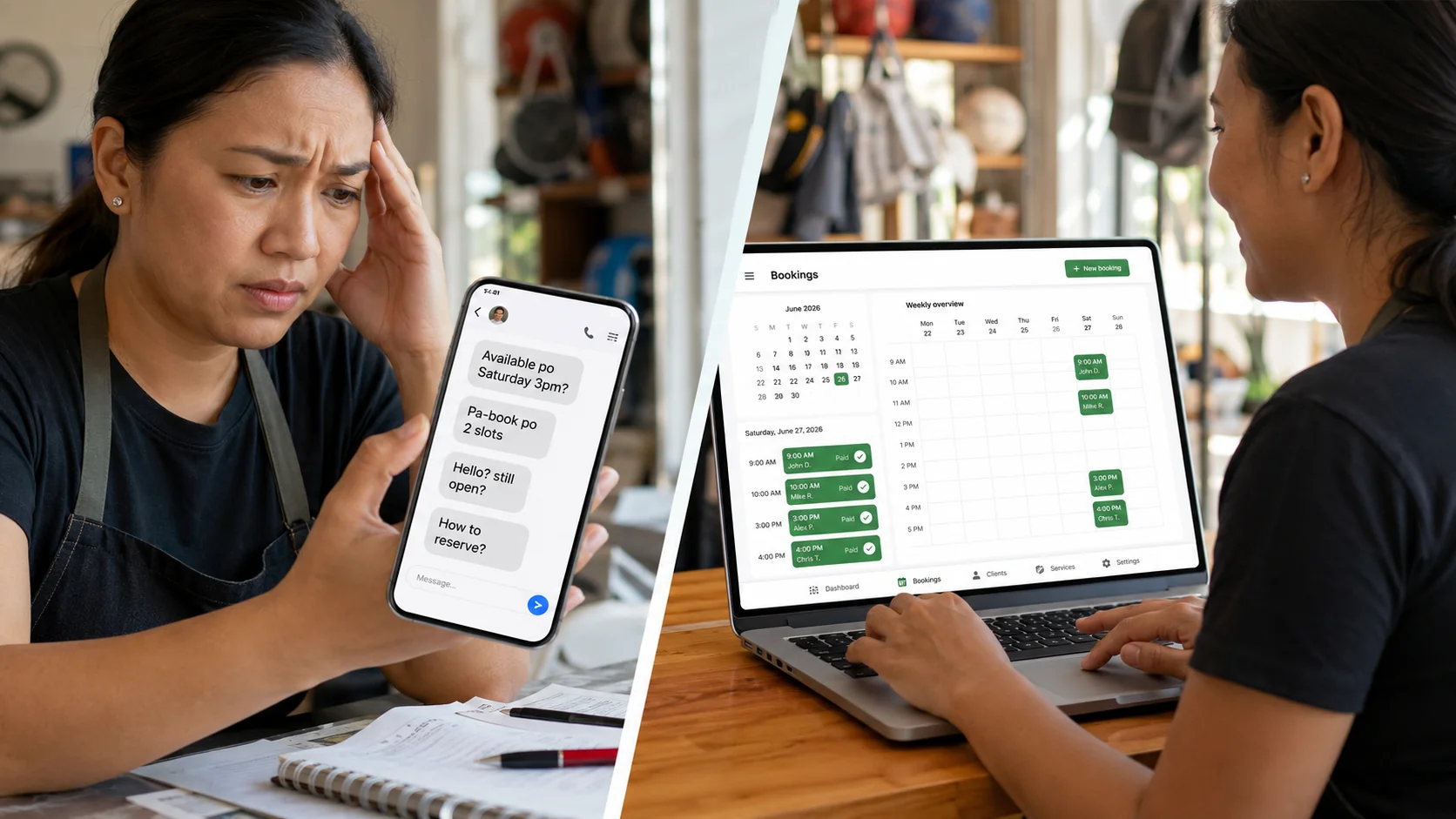
Plenty of Philippine businesses run bookings the same way: a customer messages on Instagram or Facebook, someone checks a notebook or a shared calendar, replies with what's open, waits, confirms, then reminds. It's the natural habit in a country where nearly everyone lives inside Messenger and the DMs — around 94.9% of Filipino internet users are on Facebook and 90.6% on Messenger, with Instagram at 71.2% [1]. It works, until it doesn't. Every booking is manual, and every manual step is a place to lose time, money, or a customer. Here's what a real booking system does instead, and how to tell you've outgrown the DMs.
Why do so many Philippine businesses take bookings in the DMs?
Because that's where the customers already are, and it costs nothing to start. The Philippines has roughly 95.8 million social media identities [2], and Filipinos are among the heaviest social users anywhere, spending well over 80 hours a month on these platforms [3]. Filipinos are also famously comfortable transacting by chat — "conversational commerce," where people expect to message a business before they buy, is deeply embedded here [4], and many say they're more likely to buy from a brand they can chat with directly [5]. So the DM inbox becomes the default booking desk. That's fine at a handful of bookings a week. It stops being fine when the inbox becomes the bottleneck.
What is booking through DMs actually costing me?
Mostly your time, and it's the one thing you can't get back. Every "Is Saturday 3pm still free?" is a message you have to read, check against your calendar, and answer one at a time — often while you're mid-service with someone else. Multiply that by every enquiry, reschedule, and follow-up, and you're spending hours a week being a human scheduling engine. Worse, the same chat thread mixes questions, confirmations, and payment screenshots, so bookings get buried and details get missed. The cost isn't a line on an invoice; it's the sales and rest you give up to keep the calendar straight in your head.
How many bookings am I losing after hours?
More than you'd think, because demand doesn't keep office hours. A big share of enquiries land late at night or on your day off, when you physically can't reply. In a market this quick to message a business [4], a customer who doesn't hear back in a few minutes often just books the next salon, clinic, or studio that answers. A booking page never sleeps — it takes the slot, confirms it, and collects the deposit at 11pm while you're offline, so you wake up to a filled calendar instead of a queue of messages you have to chase.
What does a real booking system actually do?
It turns the whole back-and-forth into a single page your customer uses themselves, any time:
- Shows live availability so customers pick only from slots that are genuinely open — no double-bookings.
- Takes a payment or deposit at booking (GCash, Maya, cards), so a slot booked is a slot committed to.
- Sends confirmations and reminders automatically, the single biggest lever against no-shows.
- Manages staff and resources, routing each booking to the right person, room, court, or chair.
- Runs 24/7, capturing bookings while you sleep instead of only when you can reply.
Do automatic reminders really cut down no-shows?
Yes — this is one of the best-evidenced fixes in the whole toolkit. A large Cochrane review of controlled trials found that automated mobile text-message reminders meaningfully increase attendance versus sending no reminder at all, and work about as well as a staff member phoning each customer [6]. That research is drawn from healthcare appointments abroad rather than Philippine salons or studios, but the mechanism is universal: people forget, a timely nudge helps them remember, and a booking system fires that reminder automatically for every customer without anyone lifting a finger.
Can customers pay a deposit to hold their slot with GCash or Maya?
Absolutely, and in the Philippines that's what makes deposits actually work. GCash alone reaches more than 60 million users — over 80% of Filipino adults [7] — while Maya has grown its own base into the millions [8], and roughly seven in ten Filipinos already prefer e-wallets over cards when they pay [9]. QR Ph and e-wallets now make up the clear majority of merchant payment volume [10]. Wiring a small GCash or Maya deposit into the booking step turns a casual "sana makapunta ako" into a real commitment — and gives no-shows a reason to think twice.
What will it cost me in fees to collect those deposits?
Less than one no-show, in most cases. A local gateway like PayMongo connects GCash, Maya, cards, and bank transfers to your checkout at published per-transaction rates with no setup or monthly fee [11], and Maya Business publishes comparable per-transaction rates for its own merchant tools [12]. On a modest deposit the fee is a few pesos — trivial against the full slot you'd otherwise lose when someone books and vanishes. We cover the payment side in depth in our guide to adding GCash and Maya.
How does a system stop double-bookings and juggle my staff?
By making the calendar the single source of truth instead of your memory. When a slot is taken it disappears from what everyone else can see, so two customers can't grab the same 3pm. If you run several staff, rooms, courts, or chairs, the system tracks each one separately and only offers a time when the right resource is genuinely free. That's the piece DMs can never do well: a chat thread has no idea your Saturday stylist is already fully booked, but a proper system simply won't offer that slot.
How do I know I've outgrown DM booking?
A quick gut-check. If you spend more than a few hours a week managing bookings by hand, if you've lost slots because you replied too slowly, if no-shows regularly leave you with empty time you've already paid staff for, or if you've ever double-booked and had to send that awkward apology — the manual approach is now costing you more than a system would. The tipping point isn't a headcount; it's the moment scheduling starts eating the time you should spend on the actual work.
Isn't a booking system overkill for a small business?
It's the opposite — small teams feel the manual load hardest because there's no one to hand it to. A booking page doesn't have to be complicated: for many businesses it's a single screen with services, live availability, and a deposit. If you're weighing whether to use an off-the-shelf app or a system built into your own site, our companion piece on what to look for in the best booking system walks through the trade-offs for a Philippine small business.
What does moving off the DMs look like in practice?
Simpler than most owners expect. Take Manila Football Lab, which was scheduling training sessions by hand: we built a booking system with live availability, online payment, and automatic confirmations, so players book and pay for their own slots and sessions fill without anyone chasing messages. The scheduling now runs itself. If your bookings still live in your inbox, that's exactly what our booking system development is built to fix.
Sources & references
- Filipinos' platform usage — Facebook, Messenger, Instagram reach (Digital 2026 report) — GMA News.
- Social Media Statistics in the Philippines (2026) — Meltwater.
- Philippines Digital 2026 Report — time spent on social media — Meltwater.
- Conversational commerce in the Philippines (BCG) — GMA News.
- Filipinos more likely to buy from brands they can chat with — Inquirer.
- Mobile phone messaging reminders for attendance at appointments — Cochrane.
- The Philippines Growth Dialogues: GCash user base — McKinsey.
- How to accept Maya in the Philippines — Maya user base and reach — Antom.
- Filipino e-wallet preference and registered-user projections — Antom.
- QR Ph and e-wallets dominate merchant payment volume (PayMongo data) — Manila Bulletin.
- Pricing — PayMongo.
- Maya Business — pricing.
E-wallet adoption figures, platform usage, and gateway rates change frequently and were current as of publication — confirm current GCash, Maya, and PayMongo rates before deciding. The Cochrane reminder evidence [6] is drawn from healthcare appointments outside the Philippines; it is cited for the universal mechanism (timely reminders reduce missed appointments), not for a local no-show rate.
Want bookings that run themselves? Let's map the right setup for your business.
Talk to us arrow_right_alt