How to stop scope creep before it eats your week
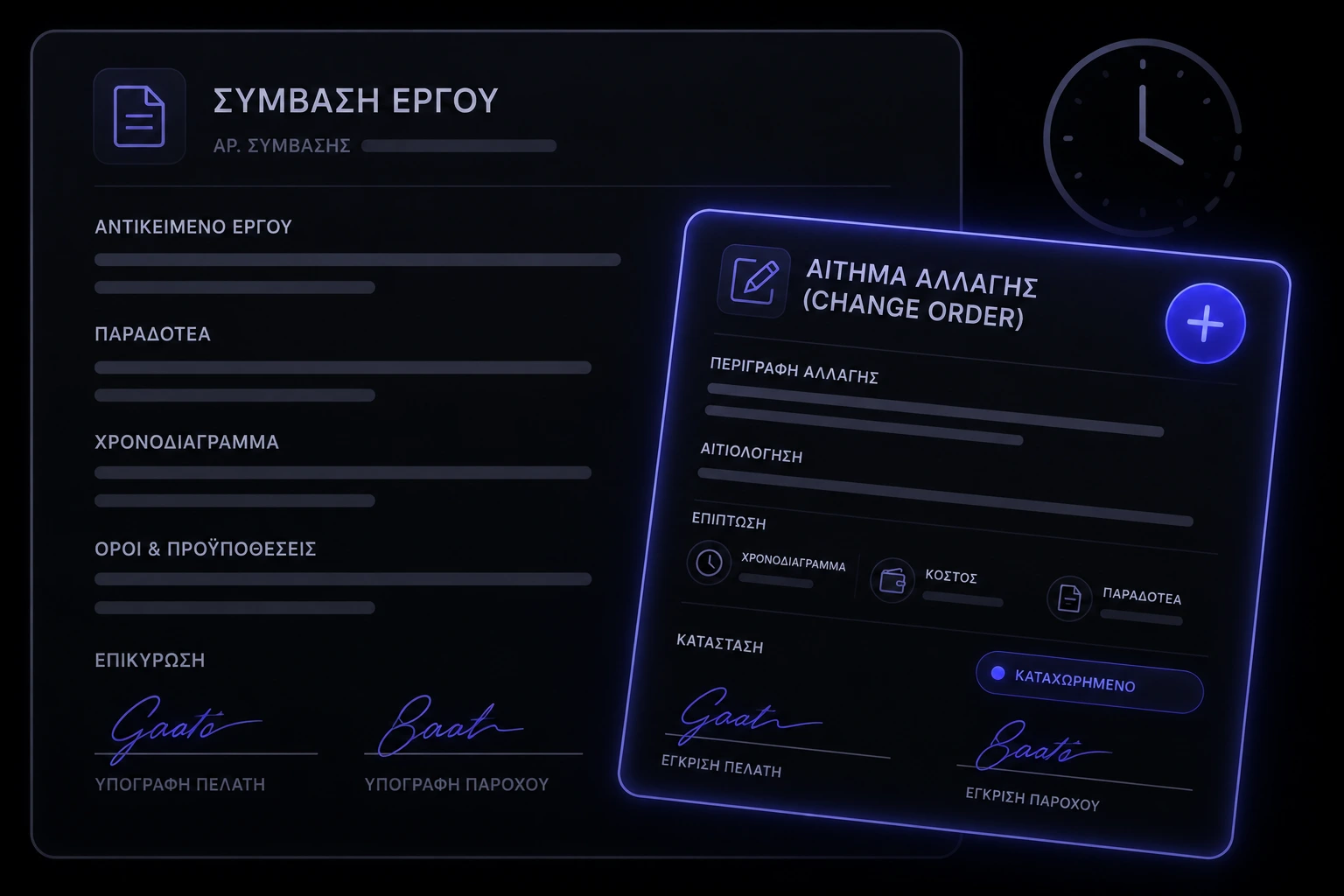
If you want to know how to stop scope creep, stop treating “just one more thing” as a kindness problem. It is a missing system: a written scope, a change-order path, and a sentence you can send without rewriting your personality. The extra hour is never one hour. It is the hour, plus the context switch, plus the unpaid revision that arrives after you already shipped.
What is scope creep in a service business?
Scope creep is extra work that lands after the price was agreed, without a new decision about time or money. In software and studio work it is rarely a villain moment. It is a sequence of polite adds: another page, another export, another round of “while you are in there.” Project-management bodies treat this as a control problem, not a manners problem — if the baseline is not written, every request looks reasonable [1] [4] [12].
- It is not the same as a bad client. Good clients ask for more when they see the work. Your job is to give that request a door, not a guilt trip [1].
- It is not the same as a change order. A logged, priced, approved add is a change. An add that disappears into the original fee is creep [9].
- It compounds. Industry research keeps putting uncontrolled change near the top of why projects miss the plan. One free tweak is a sample. Ten is a second job [2] [3].
Why do “just one more thing” requests keep landing?
Because the current path is cheaper for the client than a new quote, and you have trained them that chat is a contract. Kickoff was a call. The proposal listed “the website.” The chat thread is where the real product gets designed. Harvard Business Review’s project-management framing is useful here: if you skip a clear plan and a way to change it, the work will still change — just off the books [5]. PMI’s practical writing on reducing creep says the same thing in plainer language: name the baseline, then name the process for leaving it [3].
- Vague deliverables. “A few pages” and “make it feel premium” are not a scope. They are an invitation to keep asking.
- Yes in the moment. Whoever answers Slack at 9pm becomes the pricing committee. That is how a website development job quietly grows a booking flow, a blog, and a new logo.
- No price attached to time. If extra hours do not show up as an invoice line, they feel free. Cash-flow guidance for small firms is blunt: unpaid work is still a cost [8].
How do you write a scope that actually holds?
Write what is in, what is out, and how a change gets in. Scope management is that triangle — definition, control, and verification — not a prettier proposal PDF [4]. Treat the scope like a small business website checklist: numbered items a stranger could audit, not a vibe.
- Named deliverables. “Home, services, about, contact, plus a blog index” beats “the site.” Count pages, forms, languages, and integrations.
- Named rounds. Two design rounds and one content pass is a rule. “Until it feels right” is an open tab.
- Named outs. Copywriting, photography, a third-party app, legal review — if you are not doing it, say so on the same page as the price.
- A change sentence. One line is enough: extra requests are quoted before work starts. That line is the whole system in miniature [1] [9].
What belongs in the contract versus the kickoff notes?
The contract holds the commercial rules. Kickoff notes hold the week-one map. Mix them up and you will argue about which document “really” counted. Consumer and competition regulators in Australia and the US both care that the deal a client actually agreed to is the deal you later enforce — surprise clauses and buried traps are the problem, not a clear change-order line [6] [7].
- In the agreement. Price, payment schedule, what is included, what is excluded, how changes are requested, pause-on-nonpayment, and who owns the files. Keep it readable. Unfair or one-sided terms in a standard form are a regulatory issue, not a flex [6] [7].
- In kickoff. Dates, access, who sends copy, which tools you log into, and the first milestone. This can live in a shared doc. It should not invent new fees.
- In both, in the same words. If the proposal says two rounds and the contract says “reasonable revisions,” you have already lost the next argument. Copy the numbers.
How should a change-order system work day to day?
A change request is a logged ask: what they want, why, what it does to time and money, and a yes or no [9]. It does not need a 12-field enterprise workflow. It needs a habit your future self will actually use when a client texts during lunch. PMI’s reduction playbook is still the skeleton: capture, assess impact, get approval, then update the baseline [3].
- One intake. A form, a shared board column, or a dedicated email alias. Chat can start the thought. It cannot close it.
- A short impact note. Hours or days, fee or “in the next phase,” and what slips if they want it now. If you cannot write the impact in five lines, you do not understand the ask yet [12].
- Written approval. A reply, a signed line, or a paid invoice. Verbal “yeah go for it” is how Friday disappears [9].
- An invoice that matches. Stripe and similar tools exist so the extra work is a pay-now line, not a promise you will “catch up on billing later” [10] [11].
If you already glue intake, contracts, and billing in one place, that is business systems work — a change-order path is the same job with a different label. You are not building a PMO. You are stopping the leak.
What do you say when a client asks for extra work?
Say yes to the idea, not to the free labor. One calm paragraph beats a defensive essay. Project guides keep repeating this because it works: acknowledge, point at the baseline, offer a path [1] [12].
- The default reply. “Happy to add that. It sits outside the current scope, so I will send a short change note with timing and fee before we start.” Then send it the same day.
- If they want it inside the fee. “We can swap it for [named item] so the total stays the same, or we can quote it as an add.” Swaps are still a decision. They are not a secret discount.
- If they are in a hurry. “We can start as soon as the change is approved.” Urgency is not a reason to skip the log. It is a reason to write a shorter one [9].
Should you ever do a small extra for free?
Sometimes. A true defect is not extra work. A five-minute fix that was clearly implied by the original page is not extra work. A new page, a new integration, or a new round after sign-off is. The line is whether a reasonable person reading the original list would have expected it. If you would not have listed it in the proposal, it is not free [4] [5].
- Log the freebies anyway. A “no charge” change order still trains the path. Next time they already know how a request looks.
- Cap goodwill. One small courtesy per phase is a policy. An open tab called “tiny stuff” is how you donate a day.
- Do not hide the value. If you waive a fee, write the amount you waived. People cannot respect a number they never saw [8] [11].
How do you price extra work without starting a fight?
Price it the same way you priced the original job, then send it before anyone starts typing. A change fee that appears after the work is a surprise, and surprise commercial terms are exactly what fair-trading guidance tells you not to do [6] [7]. Use a rate card or a small menu of common adds so you are not inventing a number while annoyed.
- Hourly for messy asks. “Look at this and see” is not a fixed bid. Cap the first block (two hours, then we stop and report).
- Fixed for named extras. An extra landing page, an extra form, an extra payment method — those can have a price on a one-pager, the same way website pricing is easier when the package is named.
- Collect before you build. A hosted invoice with a card or PayPal button is the change order closing. PDF-now-pay-later is how extras become receivables [10] [11].
Do you need software, or will a spreadsheet do?
A spreadsheet is enough if you actually open it. Most teams do not. They need a list the client can see, a place to paste the ask, and an invoice that does not require a second tool hunt. Off-the-shelf project boards plus Stripe or FreshBooks-style invoicing cover a lot of studios [10] [11]. Custom is for when the handoffs are the product: the request, the quote, the approval, and the pay link have to be one motion.
That is when a thin web app earns its keep — not a miniature Jira, a form that creates a change record and an invoice. If four people already copy the same row between chat, a sheet, and accounting, software is cheaper than another “we should be better about this” meeting [3].
How do you stop the team from saying yes in chat?
Make “I will log that” the only allowed yes. Scope fails in public channels because the fastest answer wins. Give everyone one script and one place to file the ask. Pulse-style research keeps showing that process, not heroics, is what keeps a plan intact when stakeholders keep moving the target [2] [3].
- One owner for commercial yes. Designers and developers can be warm. They should not be the rate card.
- Chat is intake, not approval. Pin the change form. If the request is not in the list, it is not in the week [9].
- Review extras in the same meeting as the plan. A weekly 15-minute change review beats 40 scattered yeses. That is project control in clothes you will actually wear [5] [4].
What if the original scope was genuinely unclear?
Stop and rewrite it. Do not keep delivering into fog and then invent a change-order fight. Say you need a baseline, list what you thought was included, ask them to mark what they thought was included, and close the gap in writing. That conversation is cheaper than a month of quiet resentment. Scope definition is supposed to happen before control — if you skipped it, go back [4] [1].
If the relationship is still good, treat the rewrite as a no-charge change to the documents, then run every new ask through the new door. If they refuse to name a list, you do not have a client who wants a project. You have someone who wants a standing open ticket. Decline or move them to a retainer with a monthly hour cap so the open ticket is at least paid [8] [12].
How do you know you have actually stopped scope creep?
Count the extras that were logged, quoted, and either paid or declined. Do not count how many times you felt assertive. A working system means the week’s plan still matches Friday, or the difference has a paper trail [2] [3] [12].
- Unlogged hours this month. If this is not falling, the script is not being used. Fix the habit, not the template font.
- Share of extras that were invoiced before work. That is the change-order path doing its job [10] [11].
- Time from ask to yes or no. A request that sits for a week is still eating attention. Same-day impact notes are the standard [9].
- Team yeses in chat. Spot-check threads. If people still commit to work in emoji reactions, the owner rule is decoration.
You do not need a heavier contract. You need a list, a door for extras, and a sentence you will actually send. Write those three once, invoice the adds while they are still small [8], and keep the commercial terms as boring and visible as the original quote [6] [7]. That is how a service week stops being a donation.
Sources & references
- Atlassian — What is scope creep? Definition, examples, and how to prevent it.
- Project Management Institute — Pulse of the Profession.
- PMI — A practical approach to reducing scope creep.
- Association for Project Management — What is scope management?.
- Harvard Business Review — The Four Phases of Project Management.
- ACCC — Unfair contract terms.
- US Federal Trade Commission — Business guidance.
- US Small Business Administration — Manage your finances.
- Wrike — What is a change request in project management?.
- Stripe Docs — Invoicing.
- FreshBooks — Invoicing hub.
- ProjectManager — Scope creep: definition, examples, and how to prevent it.
Figures, product names, and pricing may change after publication; verify with the source before relying on them.
Want a change-order flow that actually holds?
Talk to us arrow_right_alt