Google Business Profile and your website: how they work together
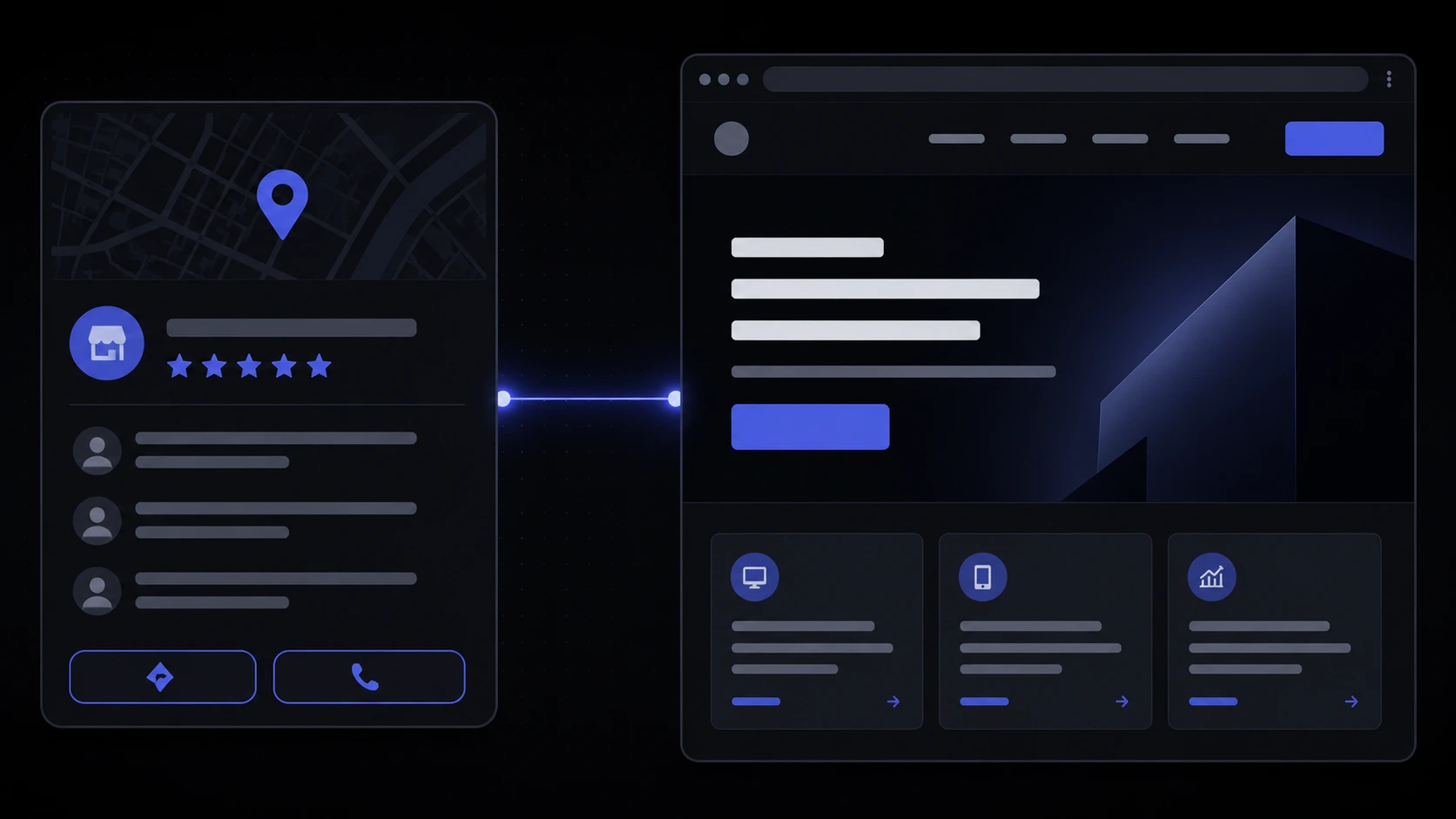
A Google Business Profile costs nothing to claim, and it shows up before your website does for anyone searching nearby — which is exactly why so many Philippine small businesses stop there. It's tempting to treat the free listing as the whole strategy, or to assume a good website makes the profile optional. Neither is true. The two do different jobs, and skipping either one quietly caps what the other can deliver. Here's how they're actually supposed to work together, and where the line sits between "good enough" and leaving business on the table.
What does a Google Business Profile do that your website can't?
A Business Profile puts your hours, directions, phone number, photos, and star rating directly inside Google Search and Maps results — before anyone has clicked through to anything. For a lot of local intent ("web developer near me," "salon open now Malate"), that's the entire interaction: a searcher checks if you're open, sees a rating, and taps to call or get directions without ever visiting a website. Your homepage physically cannot occupy that space; the profile is the only thing that can.
How does Google actually decide which businesses show up in the local pack?
Google's own guidance is specific about this: local results are ranked mainly on relevance (how well your profile matches the search), distance (how far you are from the person searching, or the area they specify), and prominence (how well-known the business is, based partly on reviews and how many places link to it) [1]. In a market like Metro Manila, where a 20-minute drive can mean a different city entirely, distance often does more work than business owners expect — a profile that's accurate down to the barangay tends to outperform one that's merely "Manila."
If you already rank on Maps, why do you still need a website?
Because a Business Profile is a summary card, not a sales page. It can show a rating and a snippet of info, but it can't lay out pricing tiers, walk through a portfolio, explain a process, or capture a lead with the right qualifying questions — all things a real website does. The profile earns the first click; the website is what turns that click into an actual inquiry. Send a skeptical prospect to your portfolio or pricing page and you close a decision the map card was never built to make.
What is NAP consistency, and why does a mismatch actually hurt you?
NAP is shorthand for Name, Address, Phone — the three details Google leans on hardest to confirm a listing is legitimate and current. Google is explicit that it compiles Business Profile information from multiple places at once: your own website content it crawls, licensed third-party data, and information contributed by users [2]. If your website footer, your Facebook page, and your Business Profile all list a slightly different phone number or an old address, you're not giving Google three confirmations of the same fact — you're giving it three conflicting signals to reconcile, which works against the "prominence" factor above. Google's own representation guidelines ask businesses to reflect their name and address "as it's consistently represented and recognized in the real world" [3] — a rule that only works if every platform you control is actually saying the same thing.
Do reviews on the profile actually move the needle, or is that overstated?
It's not overstated. BrightLocal's 2026 Local Consumer Review Survey found 97% of consumers read reviews for local businesses when deciding who to use, and 41% now say they "always" read reviews before choosing — up sharply from the year before [4]. Those reviews live and display directly on your Business Profile, visible before a single click. A profile with zero reviews, or with unanswered negative ones sitting at the top, is quietly talking a searcher out of ever reaching your website at all.
When does a Google Business Profile stop being enough on its own?
The moment your business needs more than a phone call or a walk-in to convert. Anything with a multi-step decision — a booking flow, a quote that depends on scope, an online order, a portfolio someone actually needs to browse before trusting you — outgrows what a free listing can hold. This is the same limit we cover in why a Facebook page isn't enough for your business: a single free platform you don't fully control is a fine starting point, not a finish line. If your business model has any complexity to it at all, a real site (and often a booking system behind it) is doing work the profile structurally cannot.
Does your website actually help your Business Profile rank better, too?
Yes — and this is the part that gets missed. Since Google partly builds your profile from information it crawls off your own website [2], a thin, outdated, or slow site is itself a weak signal feeding the same listing that shows up on Maps. We've covered the practical side of that separately in seven signs your website needs a redesign — the two problems usually travel together: a business whose website has drifted out of date almost always has a Business Profile that's drifted with it.
How do you keep the two working together instead of pulling apart?
Three habits cover most of it. First, make the name, address, phone number, and business category read identically on your website, your Business Profile, and every social page — pick one exact wording and copy it everywhere, including your footer and contact page. Second, point your profile's website link at the page that actually matches the search intent behind it, not always the homepage — a booking-heavy business benefits from linking straight to where someone can book. Third, treat both as living surfaces: a profile with stale hours or a two-year-old cover photo undercuts a sharp website just as much as an outdated site undercuts a well-kept profile. If you're not sure whether your current setup is doing this or working against itself, that's exactly the kind of gap worth having a developer take a look at.
Is this worth the effort for a small Philippine business specifically?
Almost certainly, and disproportionately so. Micro, small, and medium enterprises make up 99.63% of all registered businesses in the Philippines [6] — meaning most local competition is running on the same lean budget you are, not an enterprise SEO team. With 98.0 million Filipinos online at the end of 2025 [5] searching primarily by phone for exactly the kind of "near me" queries a Business Profile is built to catch, a free listing paired with even a modest, well-built website is often the highest-leverage marketing move available before spending a peso on ads. We break down what a proper build actually costs in our website cost guide if that's the next question.
Where to start
Claim and fully complete your Business Profile if you haven't — category, hours, photos, service area — then check that every detail on it matches your website and social pages word for word. If the profile is solid but the website behind it is thin, outdated, or missing entirely, that's the piece actually holding you back. Send us where things stand and we'll tell you straight whether it's a quick fix or a real project.
Sources & references
- Tips to improve your local ranking on Google — Google Business Profile Help.
- Understand how Google sources & uses info in Business Profiles & local search results — Google Business Profile Help.
- Guidelines for representing your business on Google — Google Business Profile Help.
- Local Consumer Review Survey 2026 — BrightLocal.
- Digital 2026: The Philippines — DataReportal.
- DTI Statistics (MSME Statistics) — Department of Trade and Industry.
The review-reading survey [4] is a US consumer panel, not Philippine-specific — the underlying behavior (checking reviews before choosing a local business) is a reasonable proxy but exact percentages for a Philippine audience will differ. Internet-usage and MSME figures [5, 6] are periodically-updated snapshots — reverify at the source for current numbers.
Not sure if your Google Business Profile and your website are actually pulling in the same direction? Send us where things stand and we'll give you a straight read.
Talk to us arrow_right_alt