Online booking system for small business: what phone-tag is really costing you
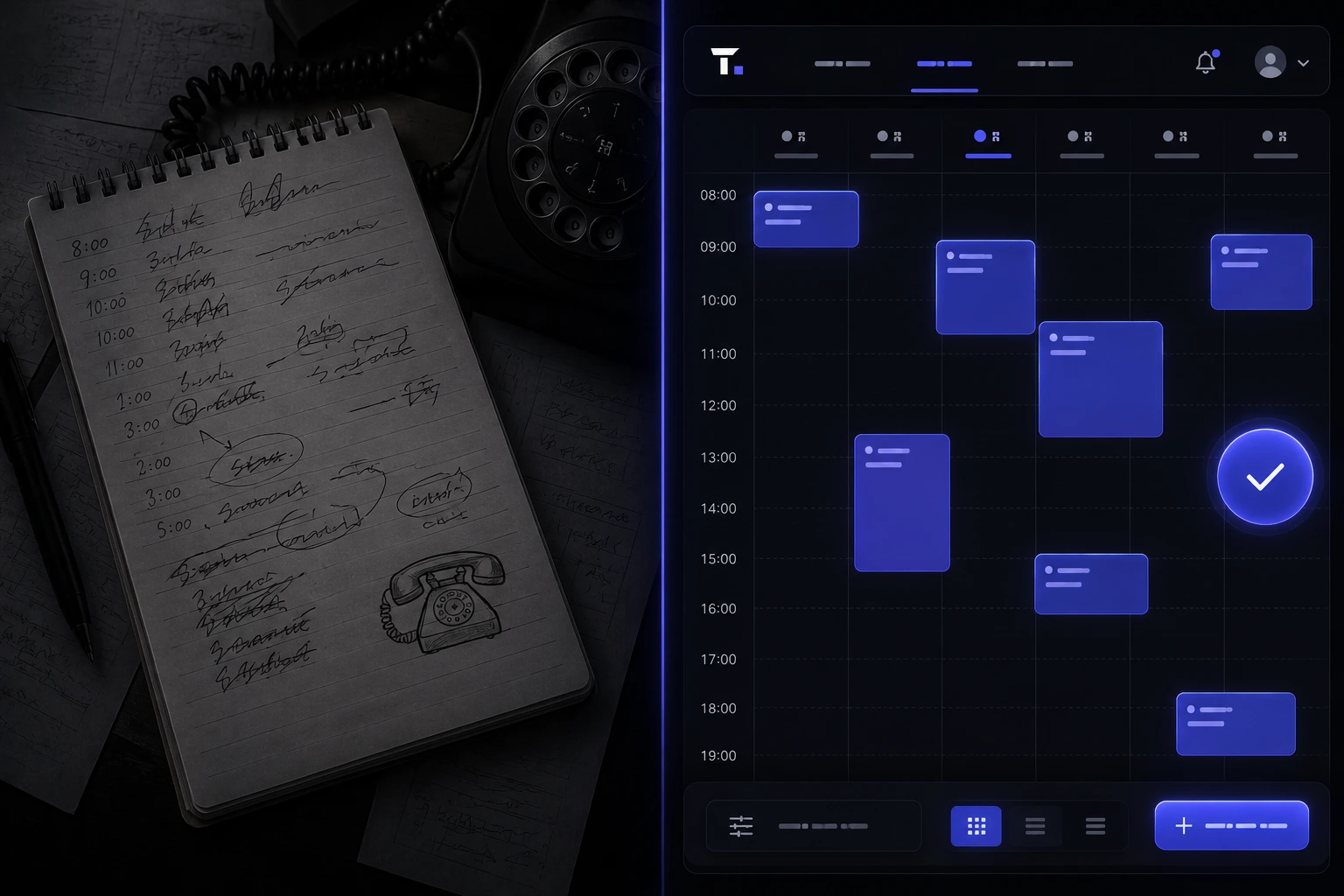
If the diary still lives next to the phone, an online booking system for small business is not a nice extra. It is how you stop paying for empty chairs that started as a missed ring. Phone-tag feels personal on your side: you picked up when you could, you called back, you left a voicemail. From the client's side it is friction. They wanted Tuesday at 3. You were with someone else. They hung up and booked the place that answered with a calendar. This is about that cost — missed calls and no-shows — and what actually changes once people can book themselves without waiting on hold.
Why do missed calls turn into lost customers instead of callbacks?
Because the client did not call to have a conversation. They called to lock a time. When nobody picks up, most people do not leave a thoughtful voicemail and wait. They try the next business that can confirm a slot in the same minute. Research on connected customers keeps finding the same pattern: people expect to complete a simple job on the channel they already opened, without a delay [6]. A booking request is a simple job.
Callbacks help with loyal regulars. They do much less for a new client who has never sat in your chair. By the time you see the missed-call list at 6pm, that person has already compared two other calendars on their phone. Mobile is how most of those comparisons happen [8]. If your only answer is "sorry, just seeing this," you were never in the running.
How much does phone-tag actually cost a service business?
Count three numbers, not one. First, the appointment you never booked because the phone rang in the middle of a session. Second, the hour you still pay a stylist, therapist, or consultant to sit in because a voicemail never turned into a confirmed slot. Third, the admin time: listening, calling back, playing phone-tag, rewriting the paper book. None of that shows up as a line item called "missed calls," which is why owners underestimate it.
A rough but honest week: ten missed rings, three that would have been new clients, two of those worth a $120 first visit. That is $240 of gross bookings you never had a chance to take, before you even talk about no-shows. Industry write-ups on missed-call loss make the same point in different markets: unanswered demand does not wait politely [1]. The fix is not "answer faster." You cannot cut hair and run a call centre at the same time. The fix is a calendar a stranger can use without you.
How do no-shows get worse when you still book by phone?
Phone bookings are easy to make and easy to forget. There is often no written confirmation the client can find later, no calendar invite on their phone, and no reminder unless a human remembers to send one. Healthcare studies on appointment failure keep showing high no-show rates when the only "system" is a conversation [2]. A salon or a consultancy is not a clinic, but the forgetting is identical.
Verbal bookings also make deposits awkward. Asking for a card while someone is on hold feels pushy, so many owners skip it. Then Saturday morning arrives with two empty chairs and a staff member you still have to pay. Automated reminders are not a personality transplant. A Cochrane review of mobile-phone messaging reminders found that automated messages increase attendance compared with no reminder at all [3]. Phone-tag has no equivalent unless you personally text every client the night before.
What changes in the first week after clients can book themselves?
The phone gets quieter, which feels wrong for a day and then feels like oxygen. New clients stop needing you to be free at the exact moment they are ready. Existing clients stop using you as a receptionist between appointments. Confirmations go out immediately. The book stops living in one person's head. That is the whole product, whether you start with a hosted tool like Calendly or Square Appointments [4] [5] or you put booking on your own site.
- Evenings and lunchtimes start filling. People browse when you are closed. A calendar does not take a lunch break.
- Double-bookings drop. Two staff members can no longer write the same slot in two notebooks.
- You see demand instead of noise. Which services, which days, which staff members actually get chosen — not just who happened to call while you were free.
If you want that calendar to look like your brand rather than a vendor's booking URL, that is booking system development on top of the site people already land on. The first-week win is the same either way: the client no longer needs you on the other end of the line to complete the job.
Will regulars hate it if they are used to calling?
Some will keep calling. Let them. Online booking is for the people you currently miss, not a law that every regular must click a button. Keep the phone. Stop using it as the only way a stranger can give you money. McKinsey's customer-experience research keeps landing on the same idea: people want the path of least effort for routine jobs, and they will punish friction even when they like you [7].
A practical split that works: regulars can still ring, and you book them in the same system so the slot is real. New enquiries get pointed at the calendar first — on the website, in the missed-call text, in the email signature. You are not being cold. You are refusing to make a new client wait on a process designed for 1998.
Is this the same problem as taking bookings in DMs?
Same family, different leak. DMs lose you people in the scroll. Phone-tag loses you people on the ring. Both are back-and-forth channels pretending to be a booking system. We already wrote about what it costs to keep bookings in DMs. Do not "solve" missed calls by moving the chaos into Instagram. You will just miss messages at 9pm instead of rings at 2pm.
If both leaks are open, pick the calendar first. One live availability source. Every channel — phone, DM, Google, the website — should write into that source, not into a notebook plus a chat thread plus whoever picked up. Otherwise you will double-book by Friday.
What should the booking page on my website actually do?
It should finish the job without a phone call. Live availability, a clear service list with duration, a confirmation the client can find later, and a reminder. If the page dumps someone onto a third-party URL with different fonts and a different logo, some of them bounce and ring you anyway. Then you have paid for software you are still operating by hand.
- Works on a phone first. Google's mobile speed research is blunt about how fast people abandon clumsy mobile pages [8]. Booking is a mobile job.
- Shows the real rules. Buffers, deposits, cancellation windows, which staff member can take which service. If the page lies, you will spend the week apologising.
- Lives next to the rest of the site. Name, hours, and the booking button should agree with each other. That is custom website development plus a scheduler, not a plugin you toggle on a Thursday.
If you are comparing a $20/month hosted link with a booking flow that stays on your domain, look at our recent work and be honest about whether the booking page is part of how you sell. For many owners the hosted link is the right first week. For others the third-party URL is the thing clients already complain about.
How do reminders and deposits cut no-shows without sounding desperate?
Two reminders is usually enough: one at booking, one the day before. The Cochrane evidence is about showing up, not about nagging [3]. More than two messages and you sound nervous. Pair the reminder with a rule that has teeth: a deposit, a card on file, or a cancellation window written in plain language. Stripe Checkout is a common way to take that deposit without inventing a payment page [10]. PayPal Checkout is the other globally recognised option if that is how your clients already pay.
Write the policy like a human. "We may charge a fee" is not a policy. "Cancel with less than 24 hours' notice and the deposit is kept" is a policy. Put it on the booking page, in the confirmation, and in the reminder. Staff should not have to argue it at the door. Software Advice's no-show guidance for appointment businesses lands in the same place: reminders plus a consequence beat hope [2].
How much does an online booking system for small business cost — and what is the return?
Hosted tools are cheap to try. Calendly and Square Appointments both publish free starting points with paid upgrades as you add staff or payments [4] [5]. Capterra's category pages are a reasonable map of the rest of the field if you want to compare features without a sales call [11]. The SaaS bill is not the real cost. The real cost is the week you still spend on the phone because the tool was never put on the website, never given a deposit rule, and never connected to reminders.
A custom booking flow on your own site is a project, not a seat licence. If you want a sense of that band, our website pricing page is the honest starting point — booking is scoped on top of how unusual your rules are. The return math is simpler than vendors make it: if the system recovers a handful of missed new-client bookings a month, or prevents a couple of no-shows you would have paid staff to sit through, it has already beaten a typical software bill. HBR's work on service reliability is useful here — customers punish broken basics more than they reward extra delight [12]. Being bookable is a basic.
How do I know it is working?
Pick four numbers and look at them every Friday for a month: missed calls that did not become a booking, online bookings created after hours, no-show rate, and time staff spent on the phone taking appointments. You do not need a fancy dashboard. A spreadsheet is enough. If after-hours bookings appear and the missed-call-to-booking leak shrinks, keep going. If everyone still rings because the button is buried, you do not have an online booking problem. You have a website problem.
Give it a real month, not a quiet Tuesday. Tell regulars once. Put the link on Google, the site, the email signature, and the missed-call text. Then stop offering to "just squeeze you in" over the phone into a slot the calendar already sold. The system only works if the calendar is the source of truth.
When should booking live on my website instead of a shared link?
Use a hosted link if you are one person, you need this week to get quieter, and you are fine sending people to a vendor URL. Put booking on your own website when the booking page is part of the sale — packages, memberships, branded experience — or when clients already bounce off a third-party domain that does not look like you. Pew's mobile research is a reminder that the phone in their hand is the whole shopfront for a lot of first visits [9]. That shopfront should feel like you.
Custom is not a personality trait. It is for when off-the-shelf tools need expensive workarounds: more than one location, staff rules that a simple scheduler cannot express, or a site you are already rebuilding and do not want a second clashing booking URL on top. If that is you, talk through the tradeoffs with us. We will tell you when a $20/month app is the right answer. That is a cheaper conversation than another year of missed rings you were too busy to pick up.
Sources & references
- Why your business cannot afford to miss another call — Forbes Technology Council.
- How to reduce patient no-shows — Software Advice.
- Mobile phone messaging reminders for attendance at healthcare appointments — Cochrane Review.
- Calendly — online meeting and appointment scheduling.
- Square Appointments.
- State of the Connected Customer — Salesforce.
- What is customer experience? — McKinsey.
- Mobile page speed and industry benchmarks — Think with Google.
- Mobile fact sheet — Pew Research Center.
- Stripe Checkout.
- Appointment scheduling software — Capterra.
- Stop trying to delight your customers — Harvard Business Review.
Figures, product names, and pricing may change after publication; verify with the source before relying on them.
Want booking that lives on your own site?
Talk to us arrow_right_alt