Wix vs custom website Philippines: when to DIY, when to build, what to choose
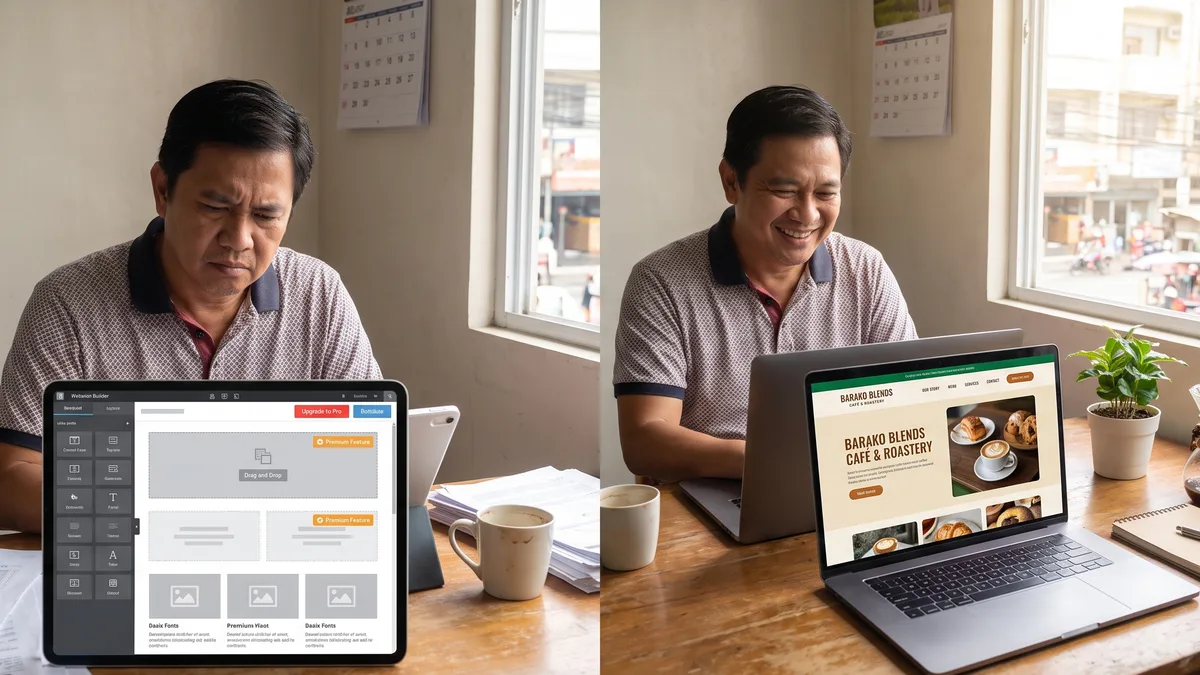
If you're a small business owner in the Philippines weighing Wix against a custom website, you've probably noticed the same thing we have at TUL-ID: the cheapest way to start isn't always the cheapest way to grow. Wix, Squarespace, and other DIY builders let you launch in a weekend for almost nothing. They also have a way of quietly getting expensive — in monthly add-ons, lost sales, and hours you'll never get back. This is a frank, question-by-question look at when a builder genuinely fits, when a custom build pays for itself, and how to decide for your specific stage in Metro Manila or anywhere else in the PH.
When is Wix genuinely the right call for a Philippine business?
More often than a web studio will admit. We tell clients this honestly, because recommending the wrong tool just means watching them overpay for it. Wix is the sensible choice when you're validating an idea — testing a new menu, a niche service, or a pop-up before committing capital — and speed matters more than polish. It's the right call when you have zero budget and no technical help, because a one-page site live this week beats a perfect site that launches in three months. And it's fine when your site is purely informational: a digital business card with your hours, location, and a contact form, no transactions or logins. If that's you, stop reading and go build it.
How much does Wix actually cost once you add everything up?
The headline is low; the real bill isn't. Wix's paid plans run from roughly US$17 to US$159 a month on annual billing [1] — very roughly ₱950 to ₱9,000 — and the cheapest tier is almost never the one a real business lands on once it needs commerce features, more storage, or the marketing tools [2]. Then the add-ons start: a booking app here, a review widget there, a form builder, an email tool. Each is its own monthly subscription in pesos or dollars, and by year two the stack often quietly costs more than a lean custom build would have — except you own none of it.
Where does a builder like Wix quietly start costing more than the sticker price?
In three places we see repeatedly across our client work. First, performance: template builders give you less room to trim page weight and control loading, and Google treats page experience and Core Web Vitals as part of how it ranks pages [3]. Second, the branding ceiling — you can change colours and fonts, but not the underlying structure, which is why two Wix sites in the same niche tend to feel identical to visitors. Third, the app fatigue above: capability you'd get natively in a custom build becomes a row of recurring subscriptions. None of these show up in month one. All of them show up by the time you're serious.
Does a slow website really lose me sales in the Philippines?
Yes, and the effect is measurable. Google's mobile page-speed research found that the probability of a visitor bouncing climbs sharply as load time stretches from one second to several [4] — the mechanism is universal, not PH-specific, but it bites harder here because the audience is overwhelmingly mobile. There were about 97.5 million internet users in the Philippines at the start of 2025 [5], and cellular mobile connections actually exceed the total population [6]. Most of your customers meet your site on a mid-range phone over mobile data, so every extra second of load time is a real customer closing the tab.
Will a Wix site rank on Google as well as a custom build?
It can rank, but you're working with less headroom. Google's own SEO guidance keeps returning to the same fundamentals — clean crawlable structure, useful content, structured data, and speed [7]. A builder handles the basics for you, which is genuinely helpful for a beginner, but it also caps how far you can push technical SEO, control your URL structure, or fix a Core Web Vitals problem at the source. For an informational site that's fine. For a business competing on search in a crowded category, the ceiling is real.
Can a Wix site accept GCash and Maya the way my customers expect?
This is the objection that decides it for a lot of PH sellers, and it's aged in favour of custom. GCash alone reaches more than 60 million users — over 80% of Filipino adults [8] — so a checkout that doesn't take it feels broken to local shoppers. A Philippine gateway like PayMongo wires GCash, Maya, cards, and bank transfers into your own checkout with no setup or monthly fee, at published per-transaction rates [9], and Maya's own base has grown fast on the banking side too [10]. On a builder you're limited to whatever payment apps it supports; on a custom site you integrate the local gateway directly and keep full control of the checkout. We walk through the setup in our guide to adding GCash and Maya.
When does a custom website actually pay for itself?
When your business depends on a system, not just a brochure — and when the market you're chasing is big enough to reward the difference. Philippine retail e-commerce was worth roughly US$17.65 billion in 2025 and is tracking toward about US$20 billion in 2026 [11], so small gains in conversion and repeat business compound quickly. Manila Football Lab came to us running bookings through Instagram DMs and a spreadsheet; we built a real system that handles court reservations, payments, and reminders — try that cleanly on a builder and you're stitching four apps together and praying during a tournament weekend. Marewear needed a storefront that looked like the brand rather than a template, so we built a custom theme and integrated their fulfillment flow. Our website cost guide for Philippine businesses breaks down what that investment actually looks like.
Do I really own my website and my customer data on a builder?
Not the way you'd think. On Wix your site lives on Wix's platform in Wix's proprietary format — you're renting the storefront and the tooling around it. You control your content and your domain, but you can't lift the actual site and host it elsewhere, and your data and integrations are shaped by what the platform allows. A custom build is the opposite: the code, the database, and the hosting are yours to move, extend, or hand to another developer. For a hobby page that distinction doesn't matter. For a business asset you're trying to grow and eventually value, it matters a lot.
How painful is migrating off Wix once I outgrow it?
Painful enough that it's worth planning around before you start. When you outgrow a builder you don't "upgrade" — you rebuild. Because the platform holds your site in its own format, the design, the page structure, the URLs, and the content all have to be recreated on the new stack, and any search ranking you'd built up is at risk during the move if redirects aren't handled carefully. We've never seen a truly clean builder migration. That's not a reason to avoid Wix at the validation stage; it's a reason to move deliberately, with a proper redirect map, the moment the site becomes central to your revenue.
Most Philippine businesses are small — are we even online enough for this to matter?
You're the exact audience it matters most for. MSMEs make up about 99.6% of business establishments in the Philippines and generate roughly two-thirds of employment [12] — but digital maturity lags the hype. Government baseline work on MSME e-commerce found a large share of small businesses still sitting at only basic digital-tool use, with many not using proper ICT tools for the business at all [13]. That gap is the opportunity: in a market this mobile and this under-digitalised, a fast, properly built site is a competitive edge, not a vanity project — and it's exactly why starting on a builder and graduating to custom is such a common, sensible path.
What's the honest decision framework for my stage?
Match the tool to where your business actually is, not where you hope it'll be. Pre-revenue or testing an idea? Start with Wix — you can rebuild later, and the money you save matters more than brand polish right now. Making money but under ₱200K a month? Either works; a custom build usually breaks even inside 6–9 months through better conversion and lower stacked tool costs. Doing ₱200K to ₱1M a month? Custom almost always wins, because a weak site is costing you more than a good one costs to build — every single month. Over ₱1M or hiring? You're past DIY and need a proper web development partner who thinks in systems, not pages.
So what should a growing PH SME actually choose?
The real question isn't Wix vs custom — it's your stage. Builders are tools; the mistake is treating them as a strategy. Three months in, Wix is fine. Three years in, if your "website" still can't tell you which product sold best last week or which channel drove last Tuesday's bookings, you've outgrown it. The point where a custom build pays for itself is almost always earlier than founders expect, because the real cost of a weak site is the customer who closes the tab and buys from a competitor. The same stage-based logic runs through our marketplace vs own store guide, and you can sanity-check budgets against our pricing. Pick the tool that fits today, and pick a partner who'll tell you honestly when it's time to move up — if a builder genuinely fits your business, we'll say so.
Sources & references
- Upgrade to a Premium Plan (pricing) — Wix.
- How much is a Wix website? — Wix Blog.
- Learn Core Web Vitals — web.dev (Google).
- The latest mobile page speed data — Think with Google.
- Digital 2025: The Philippines — DataReportal.
- PH mobile connections exceeded population (Digital 2026 report, DataReportal) — GMA News.
- SEO Starter Guide — Google Search Central.
- The Philippines Growth Dialogues: GCash user base — McKinsey.
- Pricing — PayMongo.
- Maya wins Best Digital Bank in the Philippines (Q2 2025 customer numbers) — Maya.
- Philippines E-commerce Market size and growth — Mordor Intelligence.
- DTI promotes business registration and digital readiness during MSME Week 2026 (PSA figures) — PIA.
- eCommerce Philippines 2022 Roadmap — MSME digitalisation baseline survey — DTI.
Platform pricing, e-wallet reach, market-size estimates, and digital-adoption figures change frequently and were current as of publication — reverify current Wix, PayMongo, and Maya rates and figures before making a major decision. Market-size numbers are third-party estimates that vary by methodology. Source [4] (Think with Google mobile page-speed data) is a global study, cited here for the universal load-time-to-bounce mechanism rather than a Philippine-specific figure.
Want a custom build scoped honestly? We'll tell you if a builder would actually serve you better.
Talk to us arrow_right_alt