What a fashion brand website costs in the Philippines
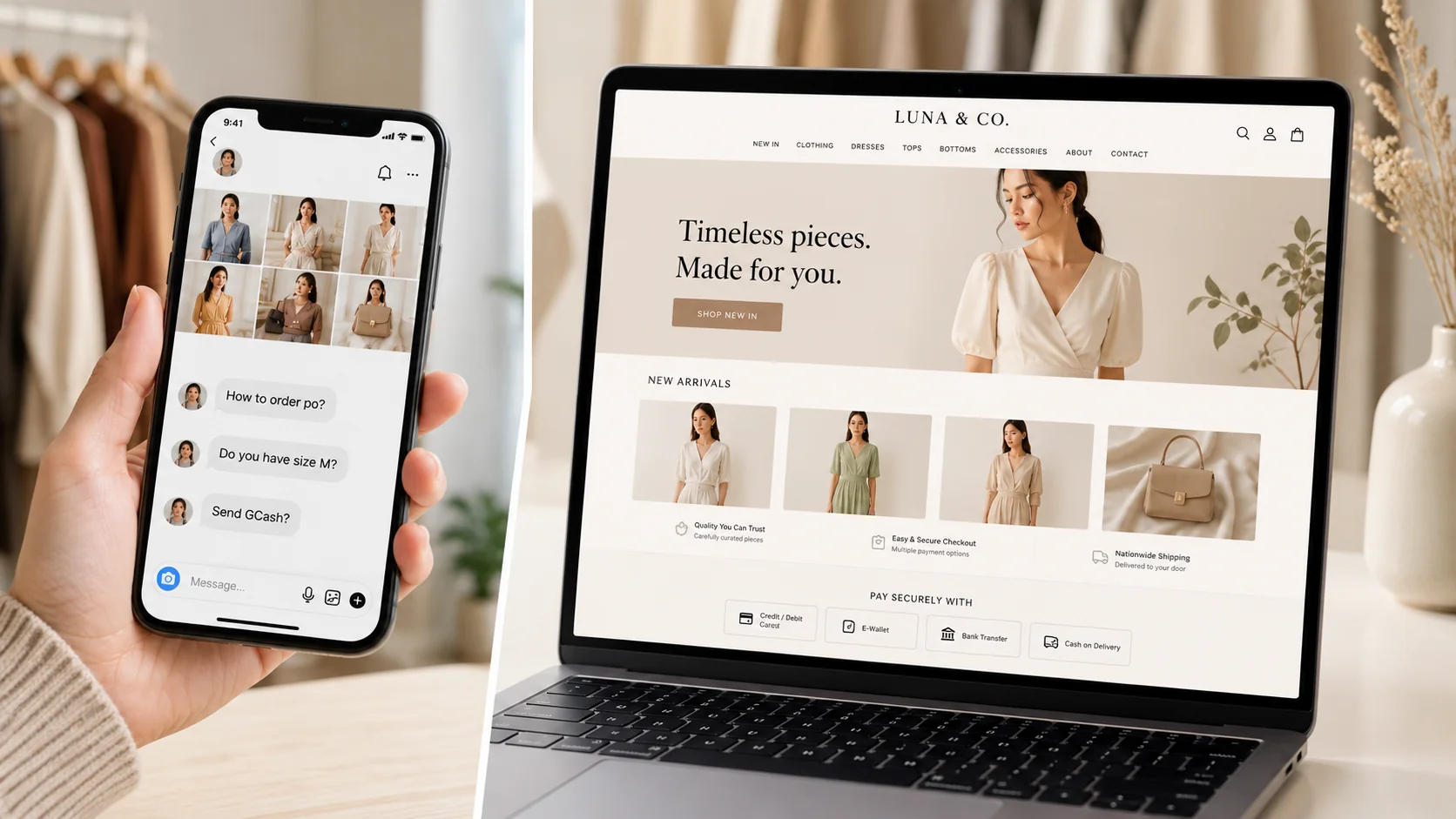
If you run a clothing label in the Philippines, you've probably asked it: what does a proper website actually cost, and is it worth it when Instagram already works? The honest answer on price is "it depends on scope" — but the demand behind the question isn't in doubt. Philippine retail e-commerce is on track to grow from roughly US$17.65 billion in 2025 to about US$20 billion in 2026, and past US$37 billion by 2031 [1]. Here's how to think about the cost so you're not comparing a lookbook page to a full store as if they're the same thing.
How big is online shopping in the Philippines, and is it still growing?
Big, and still climbing fast. The market is forecast to expand at roughly 13–14% a year through the end of the decade [1], and the buying habit is already mainstream: more than half of Filipino internet users purchase something online every week [2]. That sits on top of a deeply connected population — around 98 million people online, about 84% of the country [3] — with close to 96 million social media identities feeding the discovery layer where fashion lives [4]. The audience is there; the question is whether you capture it on a channel you own.
Forecast figures per Mordor Intelligence; (f) = forecast. Third-party estimates vary by methodology.
Is fashion a big enough category online to justify a store?
Yes — apparel is one of the most active corners of Philippine e-commerce. Fashion e-commerce in the country was generating on the order of US$460 million in monthly revenue by mid-2026 [5], and clothing and footwear consistently rank among the categories Filipinos most want to buy online [6]. For a clothing label, that means the demand isn't the problem. The problem is standing out and keeping the margin — which is exactly where an owned store beats a shared feed.
What does a fashion brand website actually cost in the Philippines?
It depends entirely on whether you're building a lookbook or a full store. As a rough guide, our own pricing starts a lean Shopify "Fashion Shop Starter" storefront from around ₱35,000, a proper launch store with a real catalogue from about ₱85,000, and a larger growth store from roughly ₱150,000 — every project scoped to the brand. Treat these as starting investments, not fixed quotes: the final number tracks the scope decisions below, not a fixed price list.
What actually drives the price up or down?
- Design depth. A branded, editorial storefront costs more than a stock theme — and for fashion, the look is the product.
- Catalog size and structure. A few hero pieces is different from hundreds of SKUs with sizes, colours, and seasonal drops.
- Selling vs showcasing. A full store with checkout, payments, and shipping is more than a lookbook that sends people to DM.
- Platform. Shopify is fast to launch and reliable; a custom or WooCommerce build trades more setup for more control.
Shopify or WooCommerce for a Philippine fashion brand?
For most local labels we lean toward Shopify: it handles inventory, checkout, and hosting out of the box, so your budget goes into design and brand rather than plumbing. Its subscription starts at about US$39 a month on the Basic plan and rises through the higher tiers as you scale [7]. WooCommerce makes sense when you want full ownership and to avoid a monthly platform fee, trading that for more setup and maintenance. Either way the point is the same — a real store you control, not a stall you rent. We compare the two in detail in our Shopify vs WooCommerce guide.
What are the monthly platform and payment costs after launch?
Budget for three recurring lines: the platform, the payment gateway, and a domain. On Shopify that's the plan fee from around US$39 a month [7]; on WooCommerce it's hosting instead. Payments are usually a per-transaction cut rather than a fixed bill — a local gateway like PayMongo charges published rates per successful transaction with no setup or monthly fee [8]. Add a domain and occasional maintenance and you have a running cost that's modest next to the margin you'd otherwise hand a marketplace on every sale.
Can my own store take GCash and Maya like the big apps do?
Yes — and this is the objection that's aged worst. GCash reports around 90 million registered users, with roughly 40 million active every month, close to half the adult population [9], and it's long been described as the leading wallet reaching more than 80% of Filipino adults [10]. A gateway like PayMongo wires GCash, Maya, cards, and bank transfers straight into your own checkout at per-transaction rates with no setup fee [8]. We walk through the setup in our guide to adding GCash and Maya. Your store can feel exactly as trusted at checkout as any marketplace.
Why do product photos and sizing matter so much for a fashion store?
Because in fashion, most returns and abandoned carts come down to two questions: how does it really look, and will it fit? Clean, consistent product photography and honest sizing guides do more for conversion than almost any feature you can buy. It's also the biggest hidden cost most brands forget to budget for — a website is only as good as the images and size charts you feed it, so plan for a proper shoot and clear measurements per style before launch.
Isn't Instagram or TikTok Shop enough on its own?
They're brilliant for discovery, and social commerce here is booming — the Philippine social-commerce market is growing at a double-digit annual rate [11] and is projected to reach nearly US$29 billion in scale [12]. But a feed caps you: you can't rank on Google, you don't own the customer list, checkout is a manual DM, and every brand looks the same. The smart play isn't either/or — it's using social to pull demand and your own store to convert loyal buyers at full margin. We unpack that trade-off in our own store vs marketplace piece.
So is a real store worth it over an Instagram shop?
For a brand that's already selling, yes. An IG shop is a rented spot on someone else's street; a real store is an asset you own. It keeps your margin, builds a customer list you can bring back, ranks on Google, and gives the brand a home that looks like you. Instagram and TikTok become the top of the funnel rather than the whole thing, and the website is where loyal customers buy at full price.
What does this look like for a real Philippine brand?
Take Marewear. The label was selling through Instagram DMs, with every order a back-and-forth message. We built it an online clothing store on Shopify — an editorial, on-brand storefront with PH-ready checkout — so customers browse and buy the collection themselves instead of messaging to order. The store now carries the brand as well as the lookbook does. If your label has outgrown the DM shop, that's exactly what our fashion brand website design is built for.
Sources & references
- Philippines E-commerce Market size, growth and forecast — Mordor Intelligence.
- Filipinos lead in online shopping (Digital 2026 Report, We Are Social & Meltwater) — GMA News.
- Digital 2026: The Philippines (internet users and online penetration) — DataReportal.
- Social Media Statistics in the Philippines (2026) — Meltwater.
- Fashion Industry in the Philippines (fashion e-commerce revenue) — ECDB.
- Best-selling products in the Philippines (fashion and footwear preference) — Accio.
- Shopify Pricing — plans and monthly fees — Shopify.
- Pricing — per-transaction rates, no setup or monthly fee — PayMongo.
- GCash registered and monthly-active user base — Daily Tribune.
- The Philippines Growth Dialogues: GCash reach among adults — McKinsey.
- Philippines Social Commerce Market trends and growth rate — IMARC Group.
- Philippines social commerce market size and forecast — Yahoo Finance / ResearchAndMarkets.
Market sizes, platform pricing, wallet adoption, and gateway rates change frequently and were current as of publication — confirm current Shopify and PayMongo rates before deciding. Peso figures reflect TUL-ID Digital's own starting investments, not third-party data. Market-size and social-commerce figures are third-party estimates that vary by methodology; Shopify plan pricing is quoted in US dollars from the vendor's global pricing page.
Thinking about a real store for your brand? Let's scope it together.
Talk to us arrow_right_alt